Introduction
Interactive design reviews are replacing the conventional presentation model across Vancouver’s most demanding architectural and development practices — because interactive design reviews show that the cost of misunderstanding a design is consistently lower when discovered during a navigable session than when it surfaces during construction documentation, planning authority submission, or — most expensively — during the construction phase itself. The traditional design presentation, however beautifully produced, is a one-directional communication event that answers the questions the design team anticipated. An interactive review gives every participant the ability to investigate the design from their own perspective and surface the questions the design team did not anticipate.
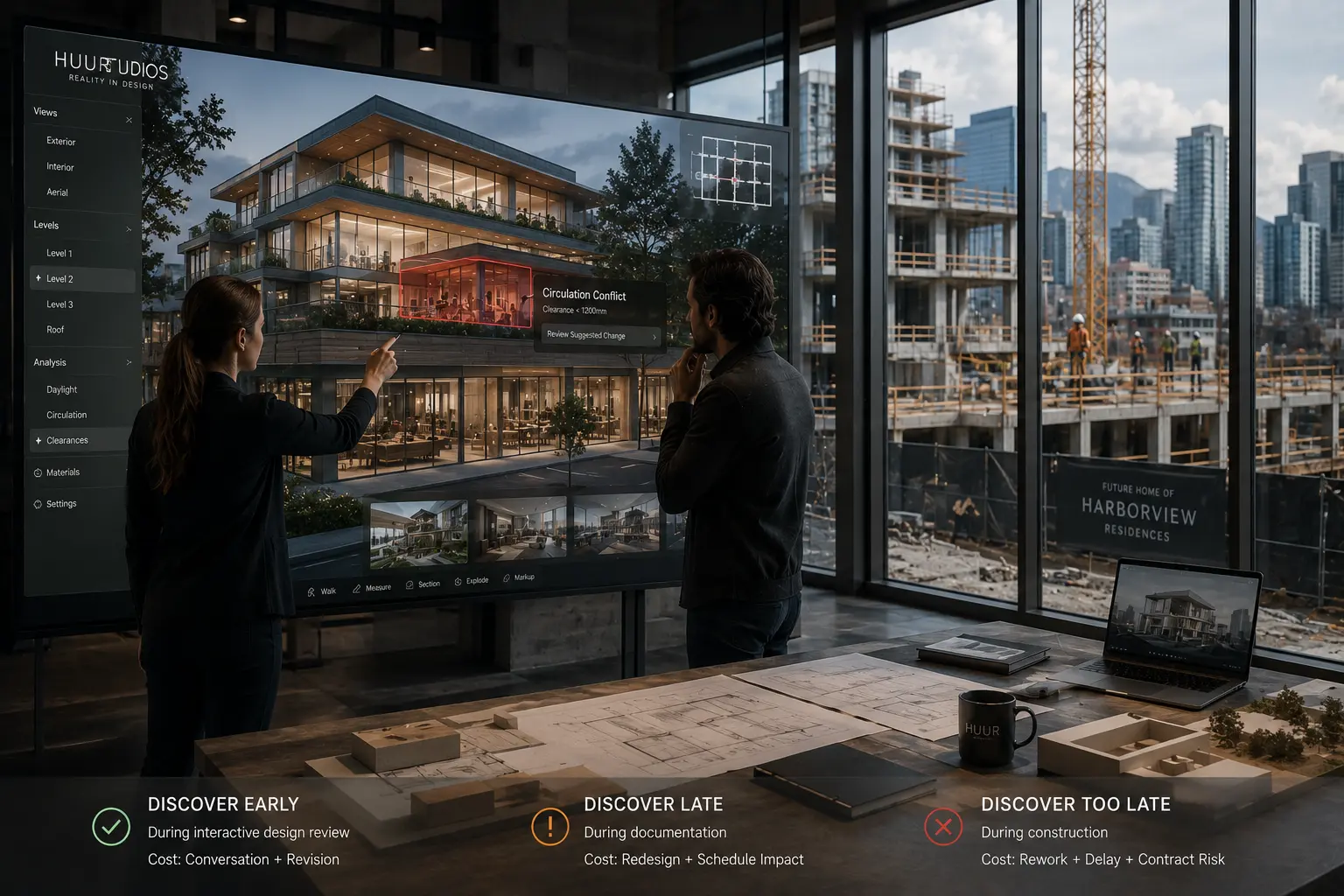
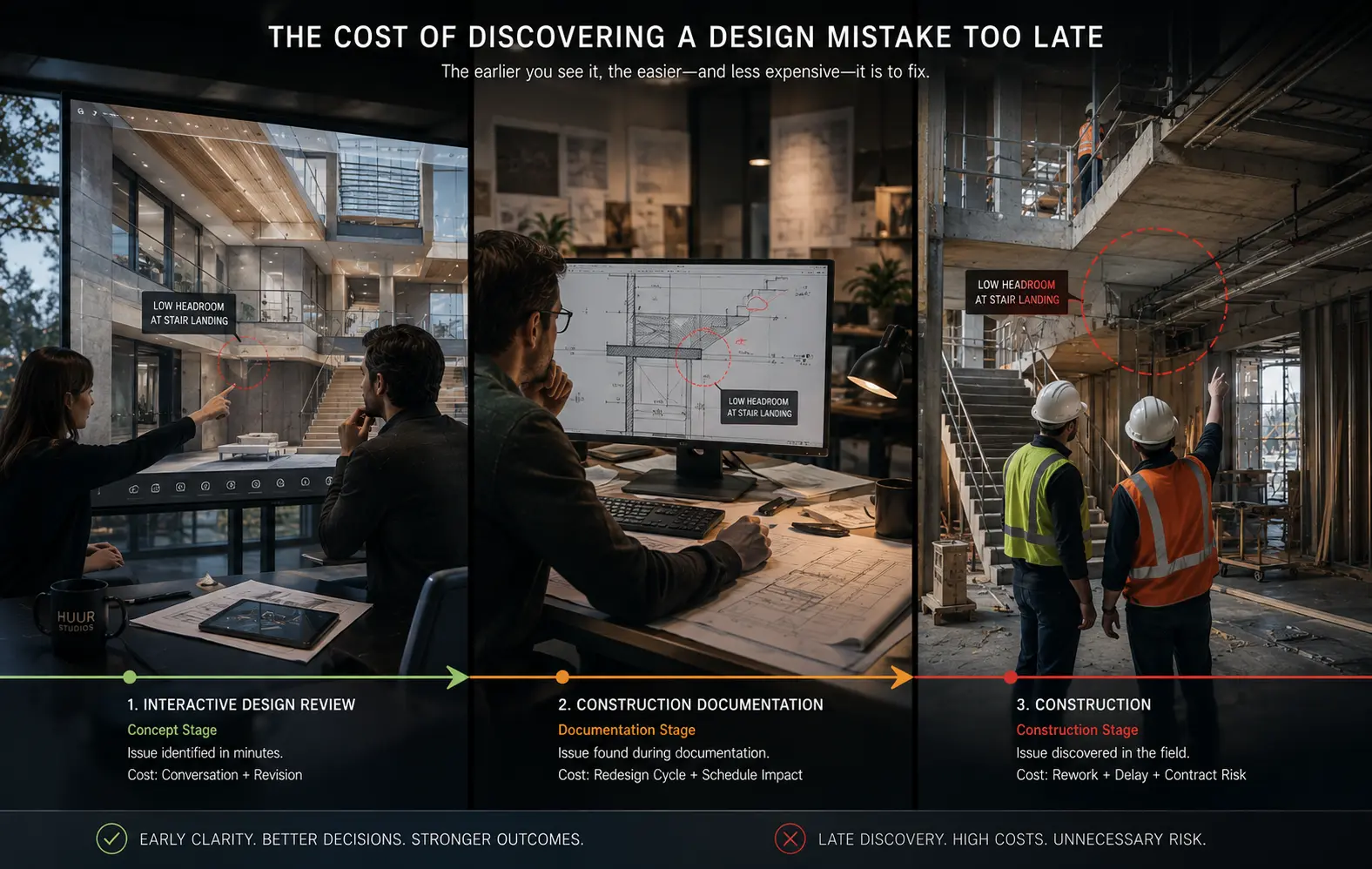
The financial argument for interactive design reviews is built — and interactive design reviews make this argument clearly on a straightforward cost asymmetry. A design misunderstanding discovered during a navigable digital review session at concept stage costs a conversation and a design revision. The same misunderstanding discovered during construction documentation costs a full design revision cycle, potentially weeks of schedule impact, and the relationship tension that arises when clients discover late in the process that what was being built was not what they believed they had approved. The same misunderstanding discovered during construction costs orders of magnitude more across rework, schedule, and contract exposure.
HUUR Studios has built its visualization and production practice to serve Vancouver architects, developers, and design firms who have recognized that interactive design reviews are not simply a more impressive version of a conventional presentation — they are a fundamentally different and more commercially effective process for design communication, client alignment, and multi-disciplinary coordination across the entire project lifecycle. This article examines why the shift to interactive design reviews is accelerating across British Columbia and throughout North America, and what specific practices deliver the strongest commercial and design outcomes from the format.
The Limitations of Traditional Design Presentations
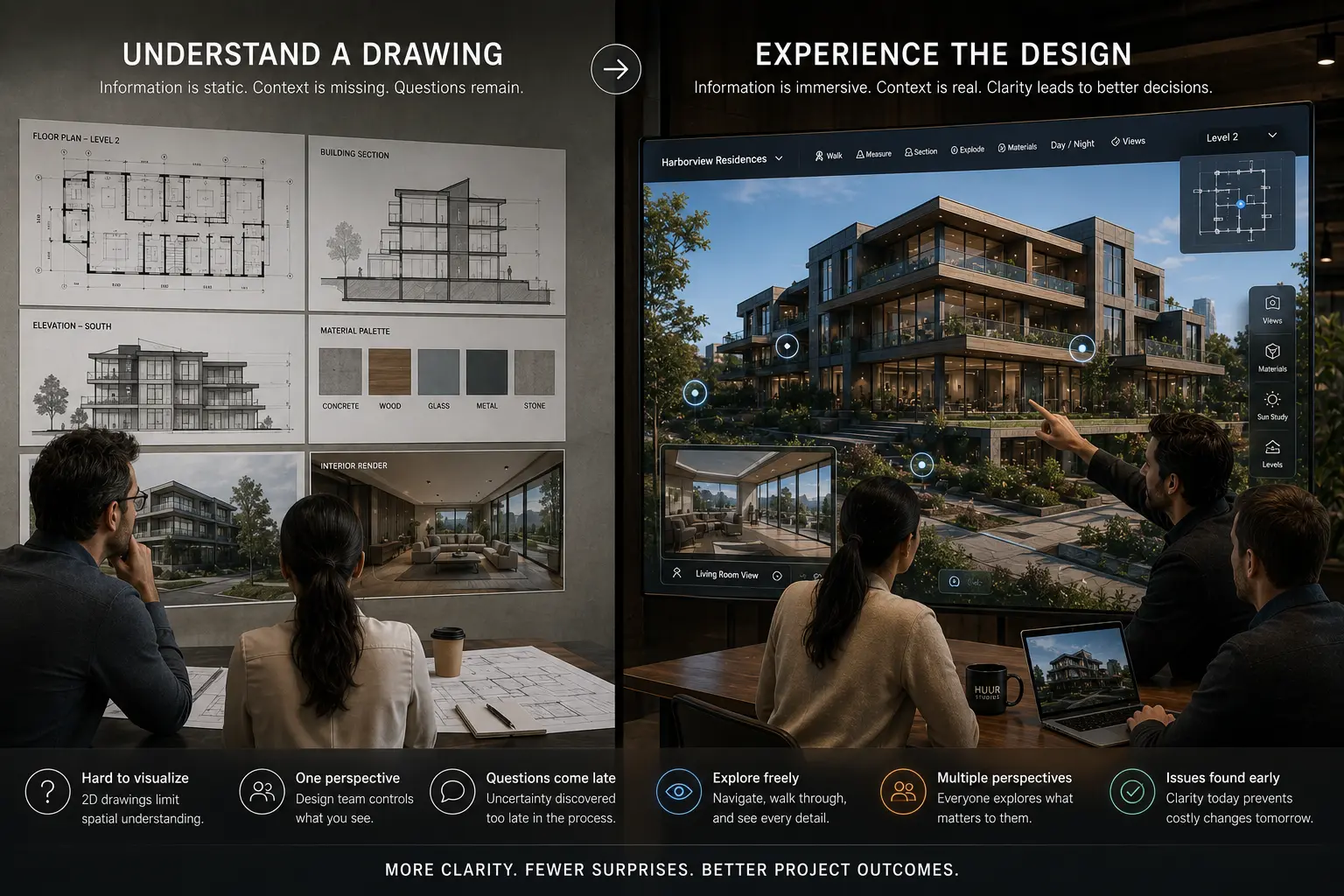
Traditional architectural design presentations rely on a communication model that has been the industry standard for decades: the design team prepares a curated sequence of drawings, renders, and physical or digital models that communicate the design from the angles and perspectives the team selected, presents them in a meeting, and asks stakeholders to form their understanding and provide feedback based on that predetermined sequence. This model places an enormous cognitive burden on non-technical stakeholders — clients, investors, and planning authorities who are expected to translate a two-dimensional representation of a three-dimensional spatial experience into genuine understanding without architectural training.
The gaps that this cognitive burden creates are the primary driver of late-stage design changes, client dissatisfaction, and the extended revision cycles that erode both project profitability and the design team’s schedule. Design visualization — even excellent design visualization — that requires imagination to bridge the gap between document and spatial reality leaves clients approving what they imagined rather than what was proposed — and that approval is frequently revised when a more developed stage of the project makes the discrepancy apparent. Interactive design reviews eliminate this imagination gap by giving every participant direct spatial exploration capability rather than asking them to form spatial understanding from curated static views.
The Information Gap in Static Presentations
A fundamental structural limitation of static presentations is that they can only answer the questions their predetermined views happen to address. When a client has a question about a specific spatial relationship — how the kitchen feels in relation to the dining area, what the view from the master bedroom window actually shows, how the building’s entry sequence will feel at pedestrian level — a static render can only answer that question if the design team happened to include that exact angle in the presentation sequence. Any question the curated sequence does not cover is left unanswered — generating exactly the uncertainty that clients carry into approvals and then surface later as revision requests.
Autodesk Revit and BIM-based design documentation solve the technical accuracy problem of interactive design reviews of design representation — ensuring that every element of the proposed design is captured with dimensional precision and specification accuracy. What they do not solve is the communication problem: how to make that precise technical documentation accessible and spatially comprehensible to the non-technical stakeholders whose approval, investment, and collaboration the project requires. Interactive design reviews built from BIM data combine technical accuracy with spatial accessibility — allowing every participant to explore the precision of the BIM model through an experience they can navigate intuitively.
The Feedback Quality Problem
Feedback quality in traditional design presentations is consistently limited by the same information gap that limits client understanding. When a client cannot fully visualize a space from the available presentation materials, their feedback is correspondingly vague — expressing a general discomfort with a spatial condition they cannot precisely identify rather than the specific, spatially grounded feedback that a design team can act on decisively. Interactive design reviews consistently produce more precise, more actionable, and more constructive client feedback because clients who can navigate directly to the element they are responding to can point to it, examine it from multiple angles, and articulate their response with the spatial specificity that comes from direct experience rather than imagination.
The improvement in feedback quality from interactive design reviews — and interactive design reviews consistently outperform static presentations on this metric — delivers direct commercial value for architecture practices because more precise feedback produces more targeted revisions that take less time to execute and less time to approve. A revision cycle triggered by vague client feedback frequently requires multiple iterations before landing on a solution that resolves the underlying concern. A revision cycle triggered by spatially specific feedback from a navigable review session targets the precise issue and resolves it in fewer design iterations.
How Interactive Reviews Improve Team Collaboration
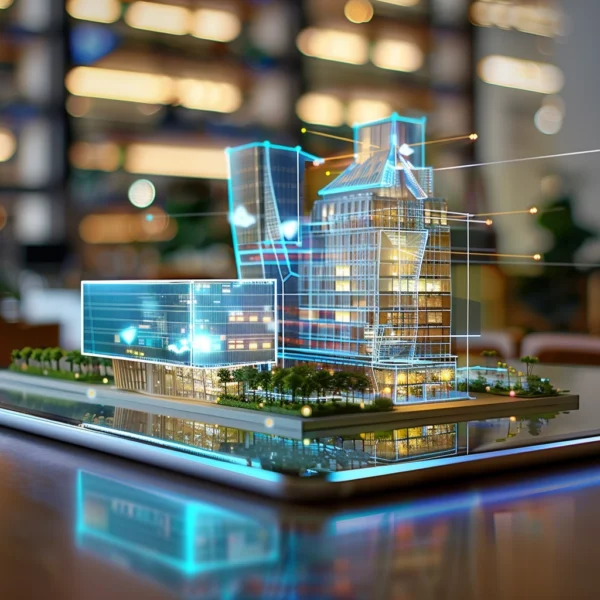
Interactive design reviews improve team collaboration by giving every participant — architects, structural engineers, mechanical consultants, interior designers, and client representatives — a shared three-dimensional reference environment they can all navigate simultaneously rather than working from separate discipline-specific documents that each team member must mentally integrate with everyone else’s. When a collaborative design review session takes place within a shared interactive environment, every participant experiences the same spatial reality at the same time — and can point to specific elements, identify coordination concerns, and propose alternatives within that shared reference rather than across the communications gap between separate documents.
The quality of coordination that shared interactive environments enable is qualitatively different from the coordination possible through document exchange and meeting-room presentations. An engineer who identifies a structural element clash with a mechanical duct run can locate both elements within the shared interactive environment, demonstrate the conflict to every participant simultaneously, and explore potential resolution approaches within the review session itself rather than through a written RFI that generates a 2 to 3 week response cycle before the conflict is even confirmed by the relevant parties.
Unreal Engine and the Real-Time Review Environment
Explore More From HUUR
10 Architectural Visualization ROI Benefits Every Developer Should Know Before Investing
Unreal Engine has become the preferred platform for high-quality interactive design reviews because its real-time rendering capability generates photorealistic spatial environments at interactive frame rates — allowing participants to navigate freely with the visual quality that communicates the genuine experiential character of a proposed design rather than a schematic approximation of it. The difference between a design review conducted in a photorealistic navigable environment and one conducted from rendered images is the difference between experiencing a space and observing a representation of it — and that experiential difference produces qualitatively stronger participant engagement and more informed design feedback at every stage of the project lifecycle.
Twinmotion provides an accessible real-time review platform for practices seeking faster production timelines with strong visual quality, particularly for its direct link workflow with Autodesk Revit and Rhino — allowing design changes in the BIM model to update the visualization environment without manual asset reconstruction. For design teams conducting iterative interactive design reviews across multiple concept development stages, this live-link workflow significantly reduces the production time required to maintain a current, accurate review environment as the design evolves through each feedback and revision cycle.
Virtual Project Review for Distributed Teams
Virtual project review capability extends the collaborative benefits of interactive design reviews to project teams operating across multiple locations — removing the logistical barriers to meaningful multi-disciplinary coordination that geography would otherwise impose. A Vancouver architect coordinating with an engineer in Calgary, a client representative in Hong Kong, and a planning consultant in Toronto can share the same navigable design environment through a web browser on any device at any hour — conducting the spatial coordination conversation that the project requires without every participant needing to be in the same physical room.
HUUR Studios builds every interactive design reviews environment for web-accessible deployment wherever technically feasible — ensuring that the architectural collaboration benefits of shared interactive environments reach every project stakeholder regardless of their geography or time zone. For Vancouver developments with international investor or client components, this accessibility removes a significant logistical constraint from the design review process across North American and global project teams.
Reducing Costly Design Changes Before Construction
The commercial case for investing in interactive design reviews is directly expressed — interactive design reviews are a risk reduction investment in the design change cost asymmetry that construction project managers know well: a design change discovered during concept development costs approximately 1 unit of effort to resolve; the same change discovered during schematic design costs 5 to 10 units; discovered during construction documentation costs 25 to 50 units; discovered during construction costs 100 units or more. Every design misunderstanding surfaced and resolved during an interactive review session at concept stage is a change avoided at a cost 100 times lower than the same change discovered in the field.
BIM-linked interactive environments make design accuracy misunderstandings visible in two directions simultaneously. They reveal spatial misunderstandings that clients and non-technical stakeholders carry — the gap between what the plans said and what the space will actually feel like — and they reveal technical coordination conflicts that multi-disciplinary review in a shared environment surfaces more reliably than sequential document exchange. Both categories of discovery deliver direct financial value by moving the identification of problems earlier in the project lifecycle where they cost least to resolve.
Architectural Collaboration and Clash Detection
Architectural collaboration within interactive design review environments enables a level of multi-disciplinary clash detection that BIM coordination workflows support technically but that meeting-room presentations of clash reports do not engage participants with as effectively as direct spatial navigation does. The best collaborative design review sessions happen when every participant can navigate directly to the location of a coordination conflict within a shared three-dimensional environment, the conversation about how to resolve it is grounded in direct spatial experience rather than in the interpretation of a two-dimensional plan or a clash report table that not every participant reads with equal comprehension.
According to analysis from Deloitte’s research on digital twins in the built environment, digital-first design coordination using interactive and data-connected environments consistently reduces design error rates and construction rework costs across complex building projects — reinforcing the commercial case for interactive design reviews as a risk reduction investment rather than simply a presentation enhancement for architectural and development practices across Vancouver and North America.
Digital Twin Accuracy and the Review Cycle
The most accurate foundation for interactive design reviews is a Digital Twin environment built directly from BIM documentation rather than produced independently from design intent. When the interactive review environment is linked to the project’s BIM model, every design revision made in Autodesk Revit is reflected in the interactive environment without requiring separate manual updates — ensuring that each review session is conducted on a current, accurate representation of the actual design state rather than on an environment that may lag behind the most recent design development.
HUUR Studios builds every interactive design review environment — and interactive design reviews built this way — from the project’s BIM documentation wherever feasible, specifically to maintain this accuracy connection throughout the design development process. Vancouver architects and developers working with HUUR Studios on multi-stage design review programs benefit from an environment that evolves with the design rather than representing a fixed snapshot that diverges from current design intent as development continues.
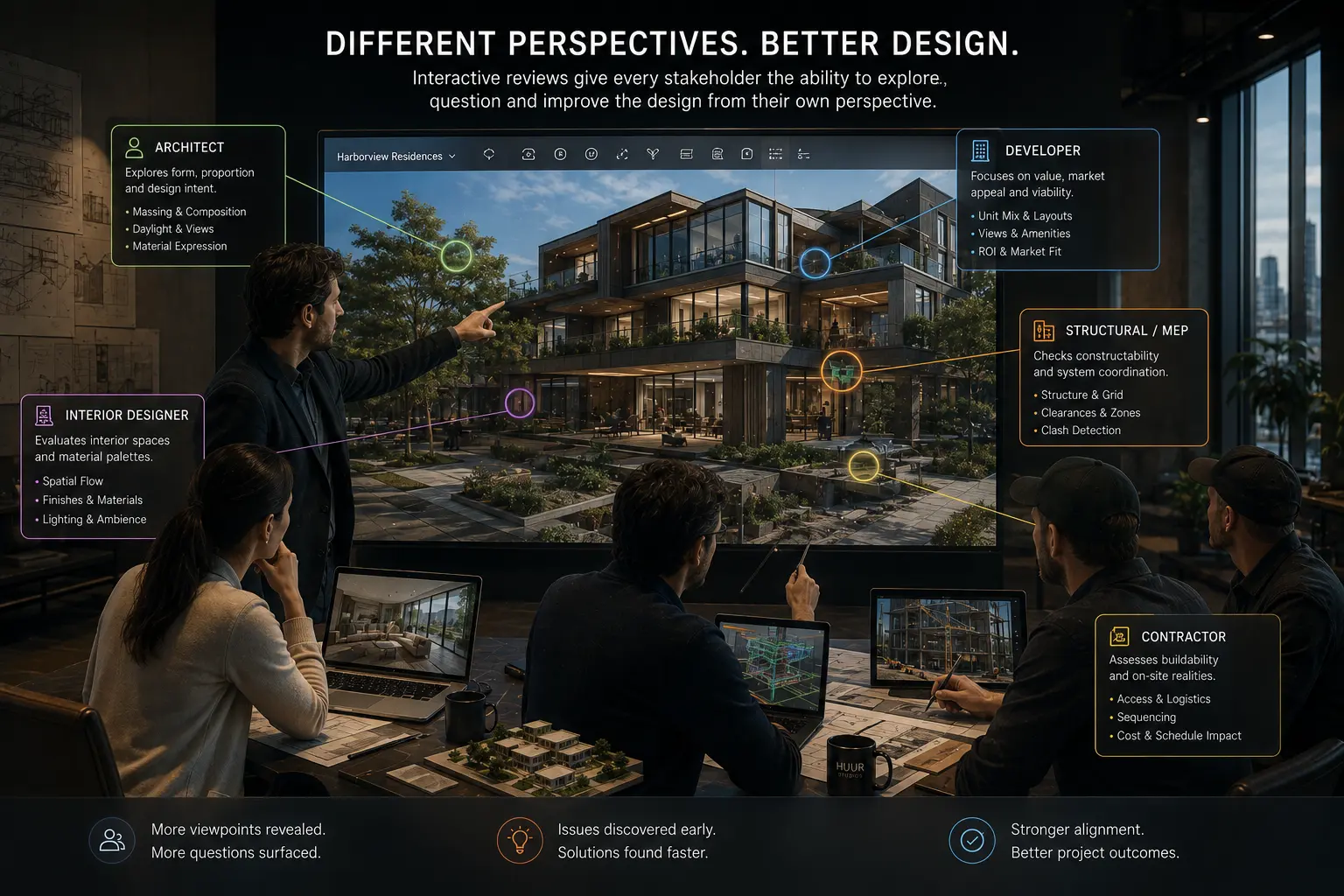
Real-Time Feedback Between Architects, Clients and Consultants
Real-time design review capability — the ability to respond to participant feedback by adjusting design parameters and showing the result immediately within the same meeting — transforms the character of architectural design review from a presentation-and-response sequence into a genuine collaborative design investigation. When a client observes a spatial condition they want to explore differently and the design team can demonstrate the alternative in real time — changing a wall’s position, removing a partition, adjusting a ceiling height — the design conversation moves at the speed of ideas rather than at the speed of render cycles that return results days later.
Interactive design reviews conducted in real-time rendering environments compress the feedback loop that traditionally stretches between design review meetings into a continuous creative investigation that produces aligned, committed decisions within the same session where questions are first raised. A client who can watch the consequences of their feedback rendered in real time — and indicate whether the adjustment resolves their concern or points toward a further exploration — leaves the meeting with genuine spatial conviction rather than provisional approval pending the next render round.
VR Design Review for Immersive Spatial Evaluation
VR-based interactive design reviews represent the highest level of spatial immersion available for design evaluation — placing participants inside the proposed design at true human scale rather than viewing it from outside on a screen. A client who has stood inside a proposed master bedroom in a VR review session, looked at the actual view, felt the actual ceiling height, and walked through the actual sequence from entry to living spaces has formed a quality of spatial understanding that no screen-based visualization format can replicate — because VR engages the same embodied spatial perception that physical architecture activates.
HUUR Studios integrates VR review capability with real-time rendering to produce VR design review environments that respond to design changes in real time — allowing clients to experience the before-and-after effect of design adjustments in the same VR session, at true human scale, with the photorealistic quality that communicates genuine spatial character rather than schematic spatial geometry.
Interactive Architecture for Planning Authorities
Interactive design reviews with planning authorities represent one of the highest-commercial-value applications of the format — because planning approval timelines are among the most significant financial schedule risks in Vancouver development, and a planning authority that can form genuine spatial understanding of a proposed development’s relationship to its context through interactive architecture makes better-informed decisions in less time than one interpreting submitted plans and elevation drawings. Faster, better-informed planning decisions reduce the review periods, additional information requests, and conditional approval exposure that generate schedule and cost risk for developers.
START YOUR PROJECT WITH HUUR
Contact our team or explain and submit your project .
Best Practices for Interactive Design Reviews
The most commercially effective interactive design reviews share structural characteristics — and interactive design reviews of this standard that distinguish them from less effective implementations of the same technology. The first is audience definition — designing each review session specifically for its participant group rather than using a single environment format for every stakeholder audience. A client review session requires a different environmental configuration and a different guided exploration sequence than a structural engineering coordination review or a planning authority contextual presentation — and treating these audiences identically consistently produces weaker results than designing each session for its specific participants and their specific evaluation objectives.
The second practice that consistently distinguishes highly effective interactive design reviews from average ones is narrative structure — beginning each session with a guided introduction that orients participants to the design before releasing them to explore independently. Participants who are given narrative context about the design’s central proposition, its key spatial ideas, and what to look for during independent exploration consistently provide richer and more design-relevant feedback than those released into self-directed navigation without contextual framing.
Real-Time Design Review Preparation and Setup
Effective real-time design review sessions require preparation that extends well beyond the technical setup of the interactive environment itself. The design team should identify in advance the specific design questions the session needs to resolve, the spatial areas where participant uncertainty is highest, and the design alternatives that might be explored if specific feedback emerges. Entering interactive design reviews with this preparation ensures that the real-time creative freedom the format enables is directed toward the decisions that matter most for the project’s progress rather than into unstructured exploration that consumes session time without advancing the project’s critical decisions.
HUUR Studios prepares every interactive design review with a session brief that defines the participant audience, the specific design questions to be resolved, the navigation sequence recommended for the guided introduction, and the design alternatives available for real-time exploration. This preparation discipline ensures that every review session produces actionable design decisions rather than general spatial impressions — and it connects directly to the architectural communication strategy that underpins every visualization engagement HUUR Studios delivers for Vancouver and North American clients.
Integrating Interactive Reviews Into the Full Project Workflow
The strongest commercial outcomes from interactive design reviews interactive property presentation come when the format is integrated into the project workflow at multiple stages — beginning at concept development where design decisions are least costly to change, continuing through schematic design and developed design where multi-disciplinary coordination reviews resolve technical conflicts, and extending into the presale and planning submission phases where buyer and authority presentations generate the commercial outcomes the development depends on.
HUUR Studios structures interactive design review programs for Vancouver architectural and development clients as multi-stage workflows rather than one-time production deliverables — building environments that evolve with the project from initial concept exploration through detailed design coordination and presale buyer engagement. This workflow integration approach maximizes the commercial return on visualization investment by ensuring the same underlying digital model serves multiple review purposes across the full project timeline.
FAQ — Interactive Design Reviews
What are interactive design reviews?
Interactive design reviews are design evaluation sessions conducted within navigable, real-time digital environments — allowing every participant to explore a proposed design from their own perspective rather than receiving a curated presentation sequence selected by the design team.
Why are interactive reviews better than presentations?
Interactive design reviews produce more precise stakeholder feedback, surface spatial misunderstandings earlier and at lower cost, and enable real-time design exploration in response to participant questions — compressing review-to-decision cycles that static presentations stretch across multiple feedback rounds.
How do architects conduct interactive design reviews?
Through real-time rendering environments built from BIM and Autodesk Revit documentation, deployed via Unreal Engine or Twinmotion for desktop and browser access, or VR headsets for immersive spatial evaluation. HUUR Studios manages the full production and facilitation process for every review session it delivers.
What software supports interactive reviews?
Unreal Engine for highest visual quality and VR capability, Twinmotion for direct Revit integration and faster production cycles, BIM-based coordination environments for technical review, and web-accessible platforms for distributed team review without hardware requirements. HUUR Studios selects the optimal format for each session’s requirements.
Conclusion
Interactive design reviews are not simply a more impressive alternative to conventional design presentations — they are a fundamentally more effective process for making design decisions with better information, aligning stakeholders with greater precision, coordinating multi-disciplinary teams with less delay, and surfacing design problems at the stages where they are least costly to resolve. The shift toward this format is accelerating across Vancouver’s most ambitious architectural practices and development firms because the commercial and design quality arguments for it are both compelling and increasingly well-documented across North American project case studies.
HUUR Studios delivers interactive design reviews for Vancouver architects, developers, and design firms as multi-stage programs integrated into the full project workflow — from concept development through multi-disciplinary coordination, planning authority presentation, and presale buyer engagement. Every environment is built from BIM documentation for design accuracy, structured with narrative preparation for participant engagement, and designed with the specific commercial objectives of each review stage as the primary production brief.
If your next project deserves the design alignment, coordination efficiency, and stakeholder conviction that only genuinely interactive design reviews can consistently produce, HUUR Studios is the partner that delivers this format at the highest available standard for the Vancouver and North American market.