
Introduction
Virtual home tours have become the deciding factor in whether a property listing captures serious buyer attention or quietly disappears into the endless scroll of competing listings — and the developers, agents, and architectural studios still relying exclusively on static photography are losing buyers before a single showing is ever scheduled. The modern home buyer in Vancouver, across British Columbia, and throughout North America browses dozens of listings in a single evening, forming impressions in seconds, and moving on the instant a property fails to capture genuine interest. A handful of flat photographs, however professionally shot, simply cannot compete with the immersive, explorable experience that virtual home tours now make possible.
The shift driving this change is not a passing trend. It reflects a fundamental change in buyer expectations shaped by the broader digital experiences people encounter every day — interactive product configurators, immersive gaming environments, and increasingly sophisticated streaming content have trained consumers to expect agency, interactivity, and genuine spatial understanding from the digital experiences they engage with. A real estate listing that offers a static slideshow in this environment does not read as classic or efficient. It reads as a missed opportunity, and increasingly, as a signal that the property or the brand behind it has not kept pace with the market.
For developers and real estate professionals competing in Vancouver’s intensely competitive presale and resale markets, virtual home tours have moved from a nice-to-have marketing enhancement to a baseline expectation that buyers now actively look for before deciding whether a listing deserves their continued attention. This article explores exactly what virtual home tours are, how they differ fundamentally from traditional photography, the technology making them increasingly sophisticated, and why HUUR Studios builds immersive residential walkthroughs that create the kind of unforgettable property experience that converts serious interest into signed offers.
What Are Virtual Home Tours?
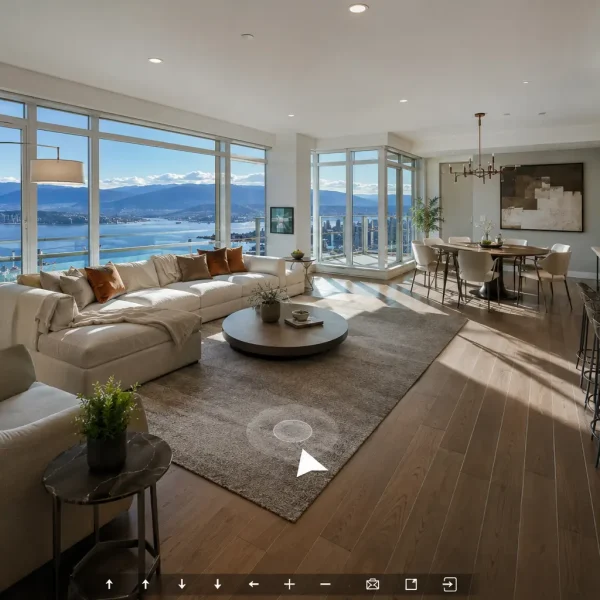
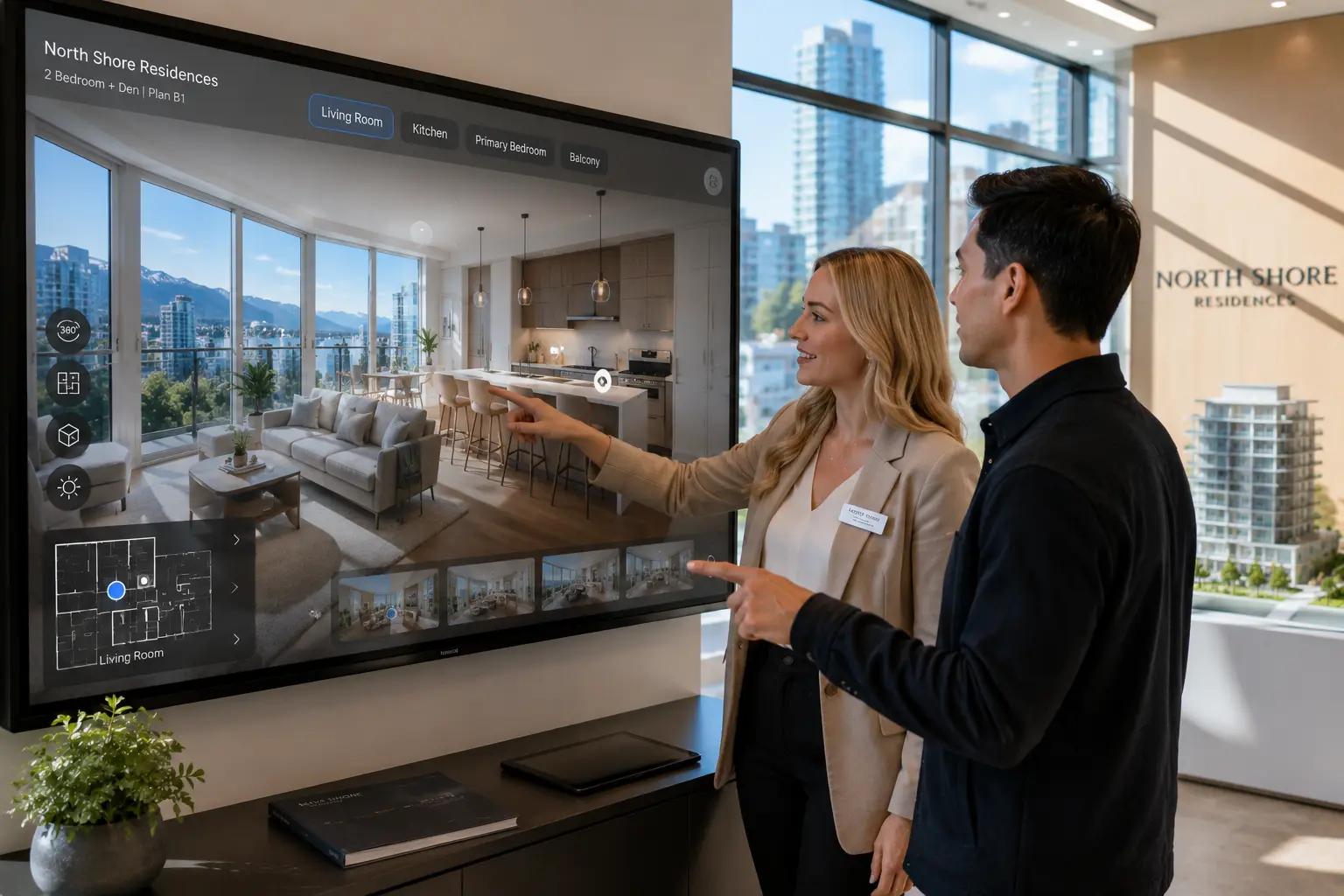
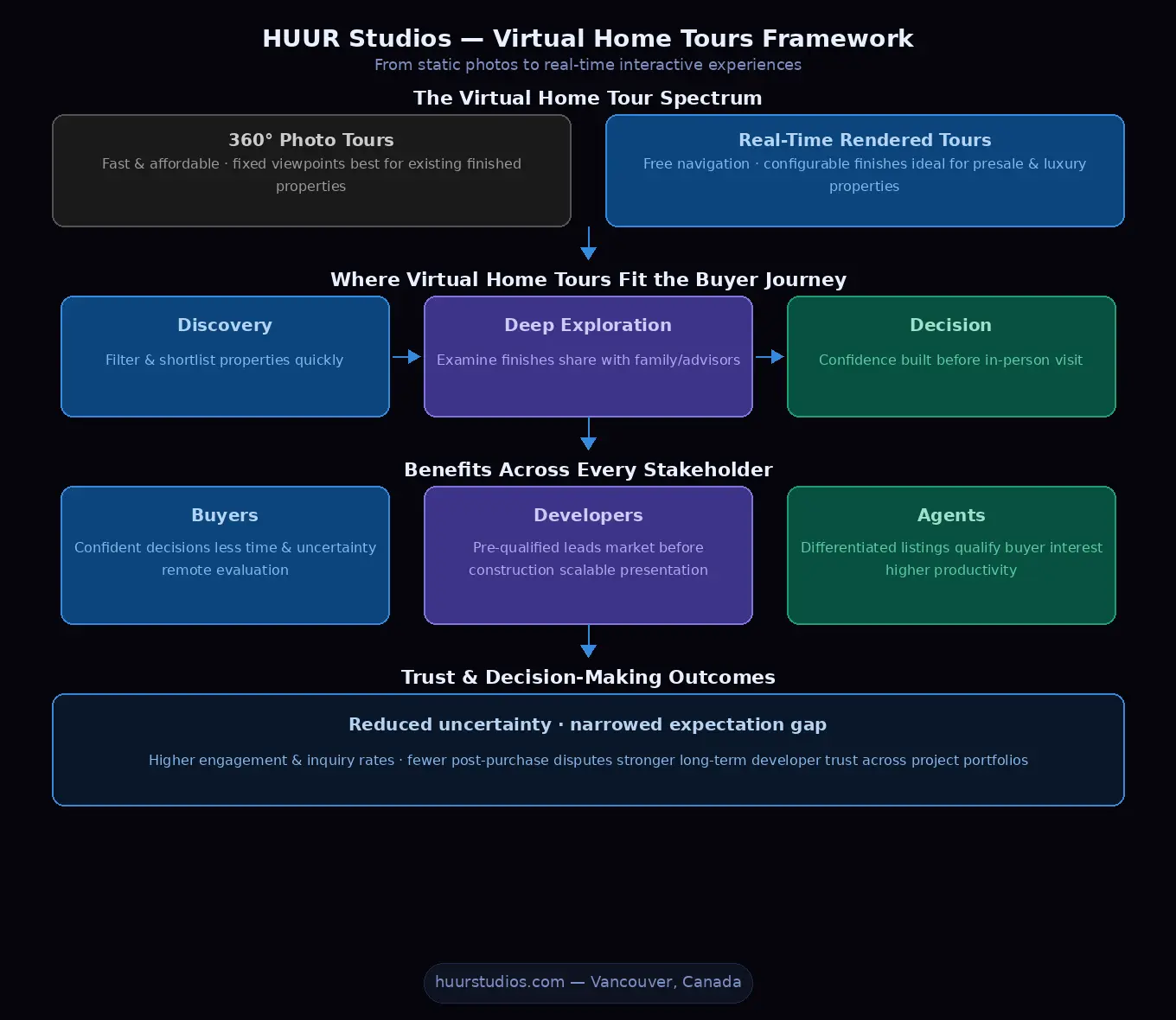
Virtual home tours are digital experiences that allow prospective buyers to explore a residential property remotely, navigating through rooms and spaces in a way that approximates or, increasingly, exceeds the experience of physically walking through the home in person. This category spans a range of technical sophistication — from simple 360-degree panoramic photo tours stitched together into a navigable sequence, to fully rendered, real-time interactive property tours built on game engine technology that allow buyers to move freely through a photorealistic digital environment.
At the simpler end of the spectrum, 360-degree photo-based virtual home tours capture a property using specialized panoramic cameras, then stitch the resulting images into a navigable experience where buyers click between rooms and look around within each captured space. This approach works reasonably well for existing, finished properties and has become a standard offering among real estate photography services across North America. It has clear limitations, however — buyers can only see the property exactly as it was photographed, with no ability to visualize alternative finishes, furniture arrangements, or lighting conditions.
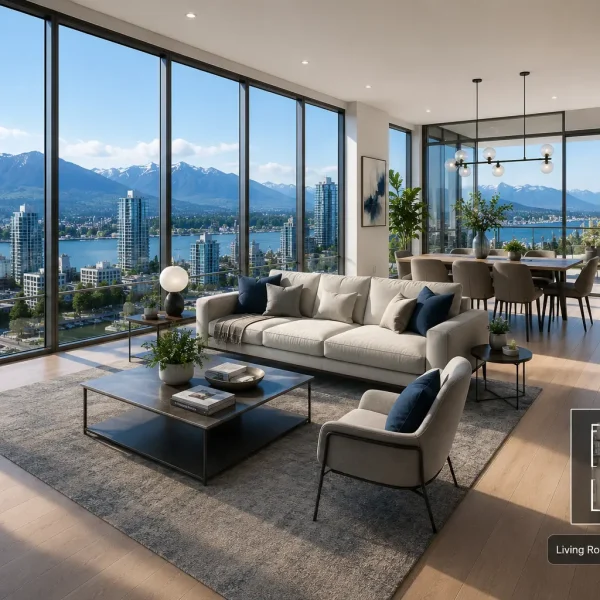
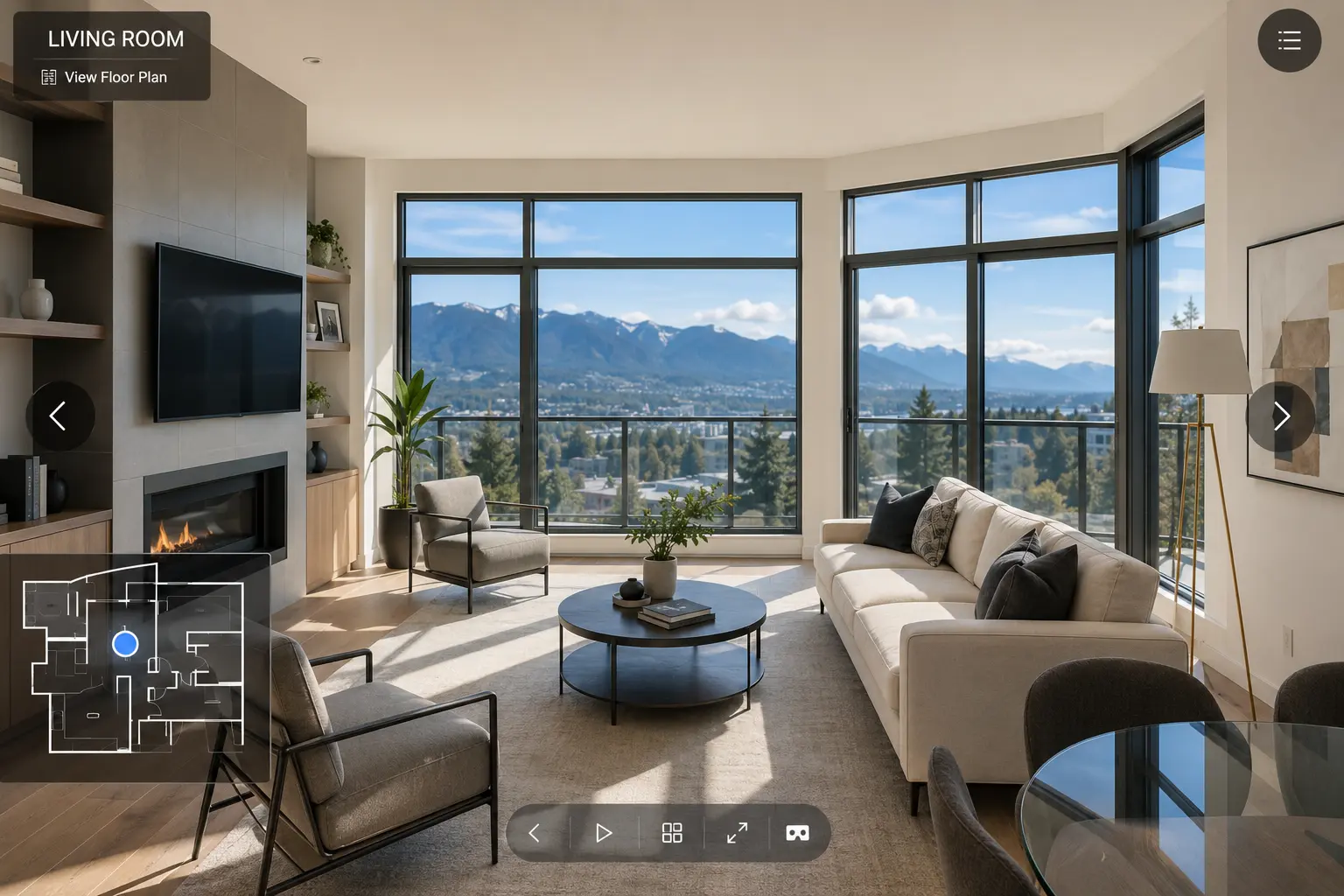
At the more sophisticated end of the spectrum, virtual home tours built on real-time rendering technology create fully digital, explorable environments that exist independently of whether the physical property has even been constructed. These virtual residential environments allow buyers to walk freely through a space, adjust time of day and lighting, swap finishes and materials, and experience a level of spatial understanding that static photography, and even basic 360-degree tours, simply cannot provide.
The Spectrum of Virtual Home Tour Technology
Understanding where a specific virtual home tour solution falls on this technical spectrum matters significantly for developers and agents evaluating their options. Basic photo-based tours are fast and relatively inexpensive to produce, making them well suited to standard resale listings where the property already exists in its final form and the marketing goal is simply accurate representation. For these contexts, digital property exploration through 360-degree photography delivers a meaningful improvement over static images alone, giving buyers a genuine sense of room flow and spatial relationships before committing to an in-person showing.
For presale developments, luxury properties, and any context where the physical space does not yet exist or where the marketing goal extends beyond simple representation into genuine buyer persuasion, real-time rendered virtual home tours deliver substantially more value. These immersive residential walkthroughs are built from architectural plans and design specifications, rendered in photorealistic quality using engines like Unreal Engine, and capable of representing finishes, lighting, and configurations that have not yet been physically built. HUUR Studios specializes in this more sophisticated end of the spectrum, building virtual home tours that function as genuine sales tools rather than simple documentation of an existing space.
Where Virtual Home Tours Fit in the Buyer Journey
Virtual home tours serve buyers at multiple distinct stages of their property search, and understanding these stages helps developers and agents deploy the right tour format for the right purpose. Early in the search process, buyers use virtual home tours to filter and shortlist properties — quickly assessing whether a space’s layout, light, and overall feel align with their needs before investing time in scheduling an in-person visit. At this stage, the goal of a virtual tour is breadth of information delivered efficiently, helping buyers self-select into or out of further consideration.
How Interactive Tours Differ from Traditional Property Photography
The difference between interactive property tours and traditional photography is not simply a matter of format — it represents a fundamentally different relationship between the buyer and the information being presented. Traditional property photography is a curated, one-directional communication. A photographer selects specific angles, lighting conditions, and compositions intended to present the property in its best possible light, and the buyer receives exactly that curated set of images with no ability to deviate from what has been chosen for them.
Virtual home tours, particularly the interactive, real-time variety, invert this relationship. Rather than receiving a predetermined set of views, the buyer actively navigates the space according to their own curiosity and priorities. A buyer who cares most about kitchen functionality can spend extended time exploring that specific room from multiple angles. A buyer concerned about natural light can adjust the virtual environment’s time of day to understand how the space performs at different points in the day. This agency fundamentally changes the buyer’s psychological relationship with the property — they are not simply viewing a representation, they are actively investigating a space, building the kind of spatial familiarity that traditionally only developed through repeated in-person visits.
The Limitations of Static Photography in Modern Real Estate Marketing
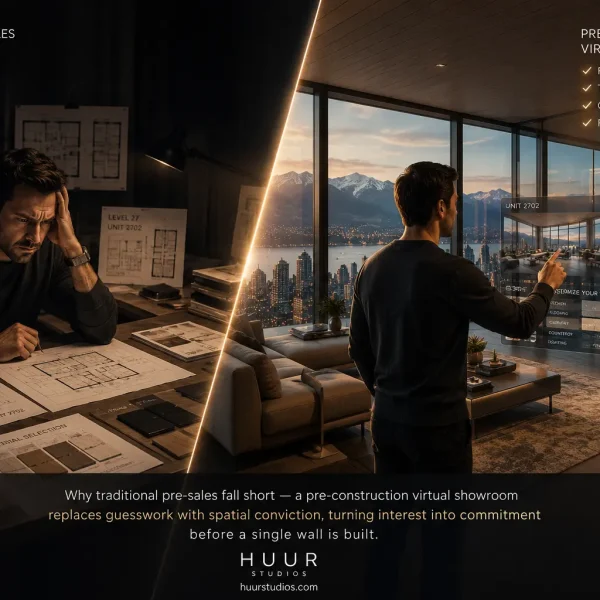
Traditional property photography, however skillfully executed, carries inherent limitations that become increasingly apparent as buyer expectations rise. A static image can only represent the property from the specific angles and lighting conditions captured during the shoot. If a buyer wants to understand how a room looks at sunset, or how a different paint color might change the feel of a space, static photography simply cannot answer that question — the buyer is left to imagine, and imagination introduces uncertainty that often translates directly into hesitation.
This limitation compounds in presale contexts, where the property does not yet exist and marketing must rely entirely on rendered or staged representations. A static rendering answers a single, fixed question about what a space will look like under one specific set of conditions. Any variation a buyer wants to explore — different finishes, different furniture arrangements, different lighting — traditionally required commissioning entirely new renders, a process that is both costly and slow. Virtual home tours built on real-time rendering eliminate this constraint entirely, allowing buyers to explore variations instantly within a single, flexible digital environment rather than waiting for new static images to be produced for every variation they want to consider.
Interactive Property Tours and Extended Engagement
One of the most commercially significant differences between interactive property tours and static photography is the engagement duration each format generates. Industry data consistently shows that listings featuring interactive virtual tours hold buyer attention substantially longer than those relying on photography alone — and this extended engagement correlates directly with stronger buyer interest and higher conversion rates into scheduled showings and offers.
According to research published by the National Association of Realtors, listings incorporating immersive and interactive media consistently generate measurably higher engagement and inquiry rates compared to listings using static photography alone — a pattern that HUUR Studios observes consistently across its Vancouver and North American client base. The explanation is intuitive: a buyer actively exploring and interacting with a space forms a stronger mental and emotional connection to it than a buyer passively scrolling through a fixed set of images, and that stronger connection translates directly into stronger purchase intent.
The Role of Real-Time Rendering in Residential Exploration
Real-time home visualization technology is what separates genuinely interactive virtual home tours from earlier generations of basic panoramic photo tours. Built on the same real-time rendering engines that power modern video games — primarily Unreal Engine in HUUR Studios’ production pipeline — these tours render photorealistic residential environments at interactive frame rates, allowing buyers to move through the space freely rather than navigating between a limited set of fixed viewpoints.
This real-time rendering capability unlocks a level of exploratory freedom that fundamentally changes what a virtual home tour can offer. Rather than clicking between predetermined hotspots, a buyer can walk continuously through a residential environment exactly as they would walking through a physically built home — approaching windows to assess the actual view, moving between rooms to understand flow and adjacency, and pausing wherever their curiosity leads them. This continuous, self-directed exploration produces a fundamentally different and more convincing sense of spatial understanding than even the most sophisticated photo-based tour can replicate.
Real-Time Rendering and Configuration Flexibility
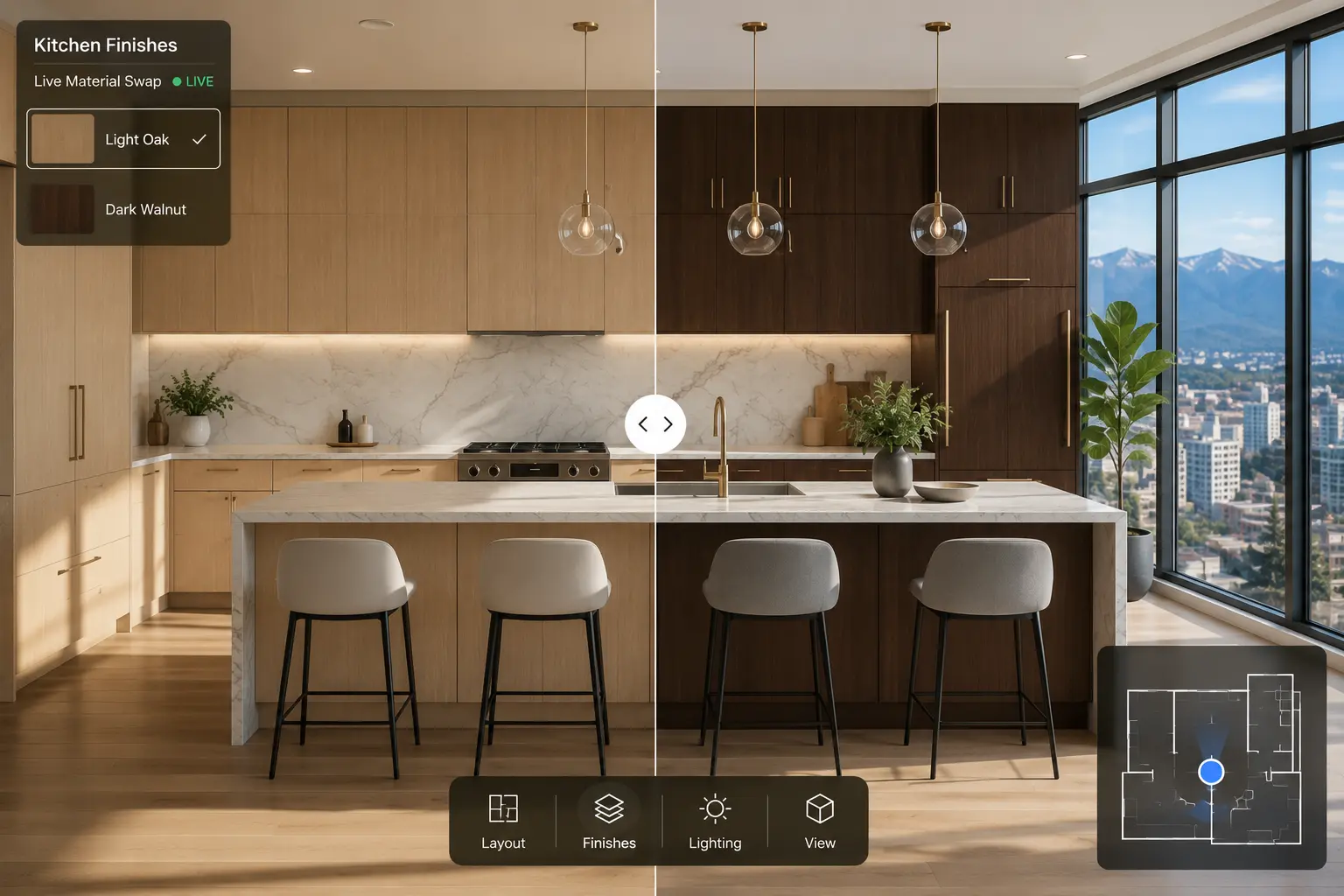
Beyond exploratory freedom, real-time rendering enables configuration flexibility that static or photo-based virtual home tours cannot match. A buyer touring a presale unit through a HUUR Studios real-time visualization can swap flooring materials, change cabinetry finishes, adjust wall colors, and modify lighting conditions instantly within the tour itself — seeing each change reflected immediately and photorealistically within the actual space they are exploring, rather than referring to a separate static rendering or sample board.
This capability is particularly valuable for developers managing presale campaigns across multiple unit types and finish packages. Rather than producing separate static marketing assets for every possible combination of layout and finish — a production burden that scales rapidly and expensively as options multiply — a single real-time virtual residential environment can represent every available configuration, with buyers exploring exactly the combination relevant to their specific unit and preferences. HUUR Studios builds this configurability into its virtual home tours as standard practice for presale developments, recognizing that the production efficiency gained scales directly with the complexity of a project’s finish and layout options.
Web-Based Accessibility and Real-Time Performance
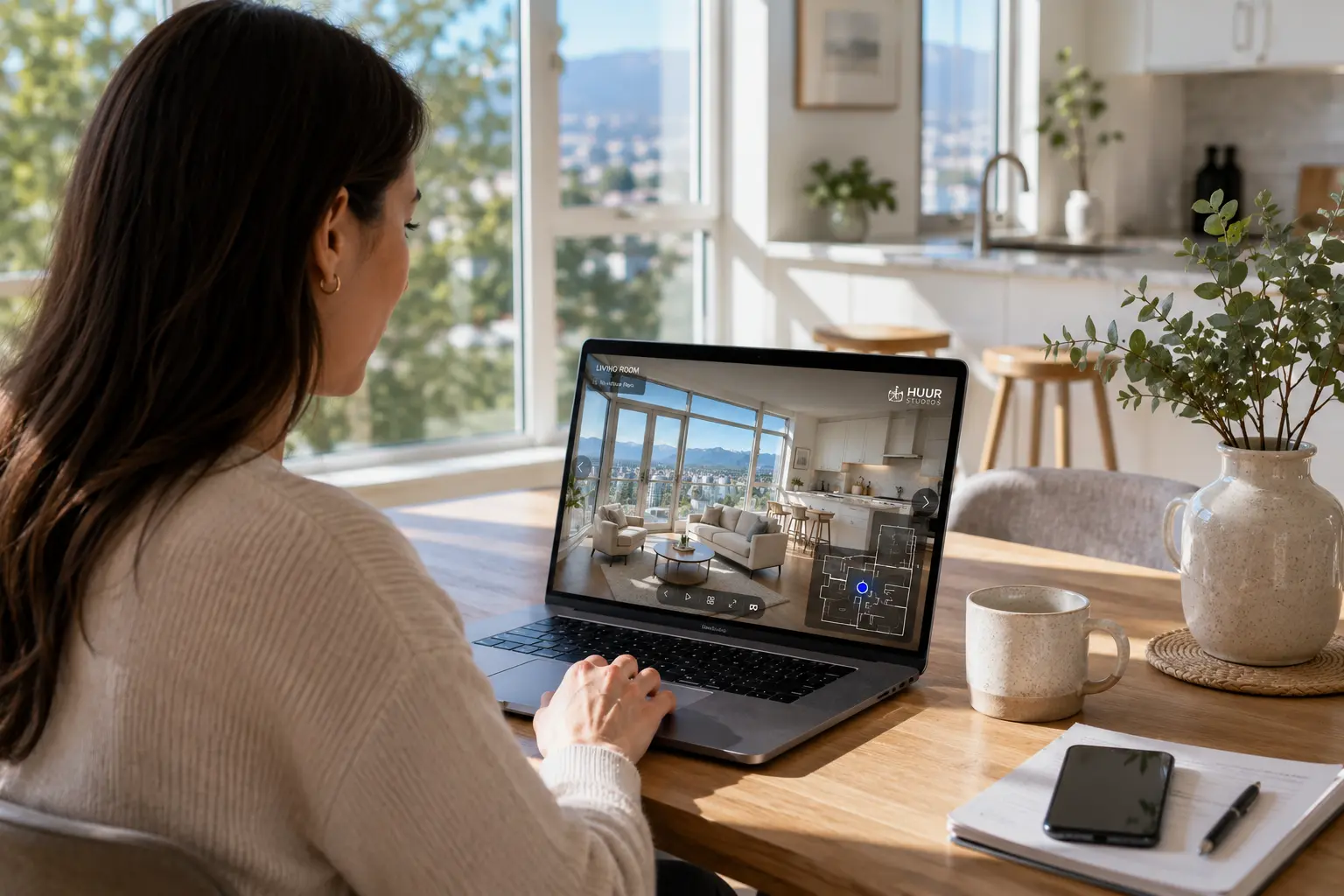
A critical technical consideration for real-time home visualization is accessibility — ensuring that the sophisticated rendering technology powering a virtual home tour does not create barriers for the buyers who need to access it. HUUR Studios builds its real-time virtual home tours for web-based delivery wherever possible, allowing buyers to access fully interactive, photorealistic property experiences through a standard web browser without downloading specialized software or owning particular hardware.
This accessibility consideration matters significantly for developers targeting international buyers, a common scenario in Vancouver’s luxury and investment-focused real estate segments. A buyer evaluating a Vancouver property from Hong Kong, London, or anywhere else in the world can access a fully immersive, real-time virtual home tour through any device with a modern web browser — removing the friction that specialized hardware requirements or app downloads would otherwise introduce into the buyer’s evaluation process.
Benefits of Virtual Home Tours for Buyers, Developers, and Agents
The commercial case for virtual home tours rests on benefits that accrue simultaneously to every participant in the real estate transaction — buyers, developers, and the agents representing properties to the market. This alignment of interests across all 3 parties is part of why virtual home tour adoption has accelerated so consistently across North American real estate markets over recent years.
For buyers, the primary benefit is informed, confident decision-making achieved with less time investment and less uncertainty. A buyer who has thoroughly explored a property through an immersive virtual home tour arrives at an in-person showing already familiar with the space, able to focus their physical visit on confirming details and addressing specific questions rather than forming basic spatial understanding for the first time. This efficiency benefits buyers managing busy schedules or evaluating properties from a distance, and it reduces the number of in-person showings required before a buyer reaches a purchase decision.
Benefits for Developers
For developers, virtual home tours deliver benefits across the entire presale and marketing lifecycle. Extended buyer engagement with virtual property tours correlates with stronger qualified lead generation, allowing sales teams to focus their time on prospects who have already demonstrated serious interest through meaningful interaction with the property rather than a brief glance at static photography. This pre-qualification effect improves the efficiency of sales team time allocation, a meaningful operational benefit for developers managing presale campaigns with substantial unit volumes.
Developers also benefit from the marketing flexibility that real-time virtual home tours provide. A single sophisticated digital property exploration environment can serve unlimited prospective buyers simultaneously, without the scheduling constraints, staffing requirements, or physical wear that in-person sales suite tours impose. For developments still under construction, virtual home tours allow marketing and sales activity to begin well before physical show suites can be completed, compressing the overall sales timeline and allowing presale momentum to build earlier in the development process.
Benefits for Real Estate Agents
Real estate agents representing properties benefit from virtual home tours through differentiated, more compelling marketing materials that distinguish their listings in competitive markets, along with the practical benefit of qualifying buyer interest before investing time in in-person showings. An agent representing a listing with a sophisticated immersive residential walkthrough can confidently direct serious online inquiries toward the virtual tour first, reserving in-person showing time for buyers who have demonstrated genuine, informed interest after exploring the space digitally.
This qualification benefit becomes increasingly valuable as agents manage growing inventories of listings across competitive Vancouver and broader Canadian markets. Virtual home tours allow individual agents to represent more properties effectively without proportionally increasing the time burden of in-person showings for every casually interested inquiry, improving overall productivity and allowing agents to focus their highest-value time on buyers genuinely close to a purchase decision.
Explore More From HUUR
Photorealistic Interior Rendering: How Stunning CGI Creates Immersive Interior Experiences and Accelerates Client Approvals

Why Immersive Home Experiences Improve Decision-Making and Trust
Immersive residential walkthroughs improve buyer decision-making by reducing the information gap and uncertainty that traditionally accompanied major real estate purchase decisions, particularly for presale properties or properties being evaluated remotely. Buyers who have genuinely explored a space through a sophisticated virtual home tour approach their final decision with substantially more confidence than buyers relying solely on static images and verbal descriptions, because the gap between expectation and eventual physical reality has been meaningfully narrowed before any commitment is made.
This confidence translates directly into measurable trust between buyers and the developers or agents presenting properties to them. A developer who provides a genuinely immersive, accurate virtual home tour demonstrates transparency and confidence in their product — implicitly signaling that the property will look and feel exactly as represented, with nothing concerning hidden from potential buyers. This transparency signal matters particularly in presale contexts, where buyers are inherently being asked to trust a representation of something that does not yet physically exist, and where that trust directly influences purchase willingness and overall satisfaction with the eventual delivered product.
Reducing Post-Purchase Dissatisfaction and Disputes
A frequently underappreciated benefit of sophisticated virtual home tours is their effect on post-purchase satisfaction and the reduction of disputes that arise when delivered properties do not match buyer expectations. Buyers who have explored a presale unit through an accurate, detailed real-time virtual home tour arrive at their eventual move-in date with expectations that have already been calibrated to the actual delivered space, substantially reducing the surprise and disappointment that drive change requests, complaints, and in some cases, legal disputes between buyers and developers.
HUUR Studios builds its virtual home tours with exactly this expectation-alignment function in mind, ensuring that the digital representation buyers explore during their decision-making process matches, as closely as technically possible, the eventual physically delivered property. This accuracy serves both the immediate marketing function of converting buyer interest into signed offers, and the longer-term reputational function of ensuring that buyers feel their expectations were honestly represented throughout their purchase journey — a reputational benefit that compounds across a developer’s portfolio of projects over time as buyer word-of-mouth and online reviews increasingly reflect satisfaction with how accurately marketing materials represented the final product.
Building Long-Term Trust Through Consistent Virtual Experience Quality
For developers and architectural firms building a portfolio of projects over multiple years, consistent investment in high-quality virtual home tours builds a cumulative reputation for transparency and product quality that influences buyer confidence even before a specific new project’s virtual tour has been explored. Buyers who have had positive experiences with a developer’s previous virtual home tours, and who found those experiences accurately represented the eventual delivered properties, approach that developer’s future projects with elevated baseline trust.
HUUR Studios works with Vancouver and North American developers specifically to build this kind of consistent, trustworthy virtual experience quality across entire project portfolios — recognizing that each individual virtual home tour contributes not just to that specific project’s sales performance, but to the developer’s broader market reputation for representing their properties honestly and compellingly across every project they bring to market.
FAQ — Virtual Home Tours Explained
1. What are virtual home tours?
Virtual home tours are digital experiences allowing buyers to remotely explore residential properties, ranging from simple 360-degree photo tours to fully interactive, real-time rendered environments. They let buyers navigate spaces, assess layout and light, and build genuine spatial understanding before an in-person visit.
2. How do virtual home tours work?
Virtual home tours work through either stitched 360-degree photography creating navigable panoramic sequences, or real-time rendering engines like Unreal Engine generating fully explorable, photorealistic digital environments. The latter allows buyers to move freely, adjust lighting, and explore finish variations interactively.
3. Are virtual home tours interactive in real time?
The most sophisticated virtual home tours, built on real-time rendering technology, are fully interactive — allowing buyers to navigate freely, adjust time of day, and swap materials or finishes instantly. Basic photo-based tours offer limited interactivity, restricted to navigating between fixed captured viewpoints.
4. Why are virtual property tours becoming more important in real estate?
Virtual property tours have become essential because modern buyers expect interactive, immersive digital experiences and quickly lose interest in listings offering only static photography. They extend buyer engagement, qualify serious interest earlier, and help developers and agents convert online attention into scheduled showings and offers.
Every property has a story—but buyers don’t fall in love with floor plans or photographs. They connect with places they can experience.
Whether you’re marketing a luxury residence, launching a pre-construction development, or looking to elevate your real estate brand, immersive virtual home tours give buyers the confidence to move from curiosity to commitment before they ever step inside.
At HUUR Studios, we design cinematic, real-time virtual experiences that help developers, architects, and real estate teams showcase properties with greater clarity, stronger emotional impact, and measurable commercial results.
From interactive walkthroughs to fully immersive digital environments, we create experiences that don’t just present properties—they help sell them.
Let’s build a virtual home tour that turns your next project into an experience buyers will remember.
Conclusion
START YOUR PROJECT WITH HUUR
Contact our team or explain and submit your project .
Virtual home tours have moved decisively from marketing novelty to commercial necessity for developers, agents, and architectural studios competing for buyer attention across Vancouver, British Columbia, and North America’s increasingly digital-first real estate markets. The gap between properties offering only static photography and those offering genuinely immersive, interactive digital exploration is no longer a matter of marketing polish — it is a measurable factor in which listings hold buyer attention, generate qualified inquiries, and ultimately convert interest into signed offers.
The technology underpinning the most sophisticated virtual home tours has matured to the point where real-time rendered, fully interactive residential environments are commercially accessible to a far broader range of developers and properties than was true even a few years ago. HUUR Studios has positioned itself at the leading edge of this capability, building immersive residential walkthroughs, real-time home visualization, and interactive property tours that do not simply document a space but create the kind of unforgettable, emotionally engaging property experience that modern buyers increasingly expect and actively seek out before committing their time to an in-person showing.
For developers and agents who recognize that buyer attention has become the scarcest resource in modern real estate marketing, investing in genuinely sophisticated virtual home tours is no longer optional differentiation. It is the baseline standard required to compete effectively for the buyers who will determine the success of every project brought to market. If your properties deserve to be experienced rather than simply photographed, virtual home tours built to this standard are exactly what HUUR Studios delivers.