Introduction
XR in architecture is redefining how buildings are designed, presented, and sold — and the studios, developers, and real estate brands that understand this shift are gaining decisive advantages in North America’s most competitive markets. XR — the umbrella term for virtual reality, augmented reality, and mixed reality — has moved from experimental technology to practical commercial tool faster than almost any other innovation the architectural visualization industry has absorbed. In Vancouver, across British Columbia, and throughout North America, the adoption of XR in architecture is accelerating because the results are measurable and the competitive gap between those using it and those not is widening every quarter.
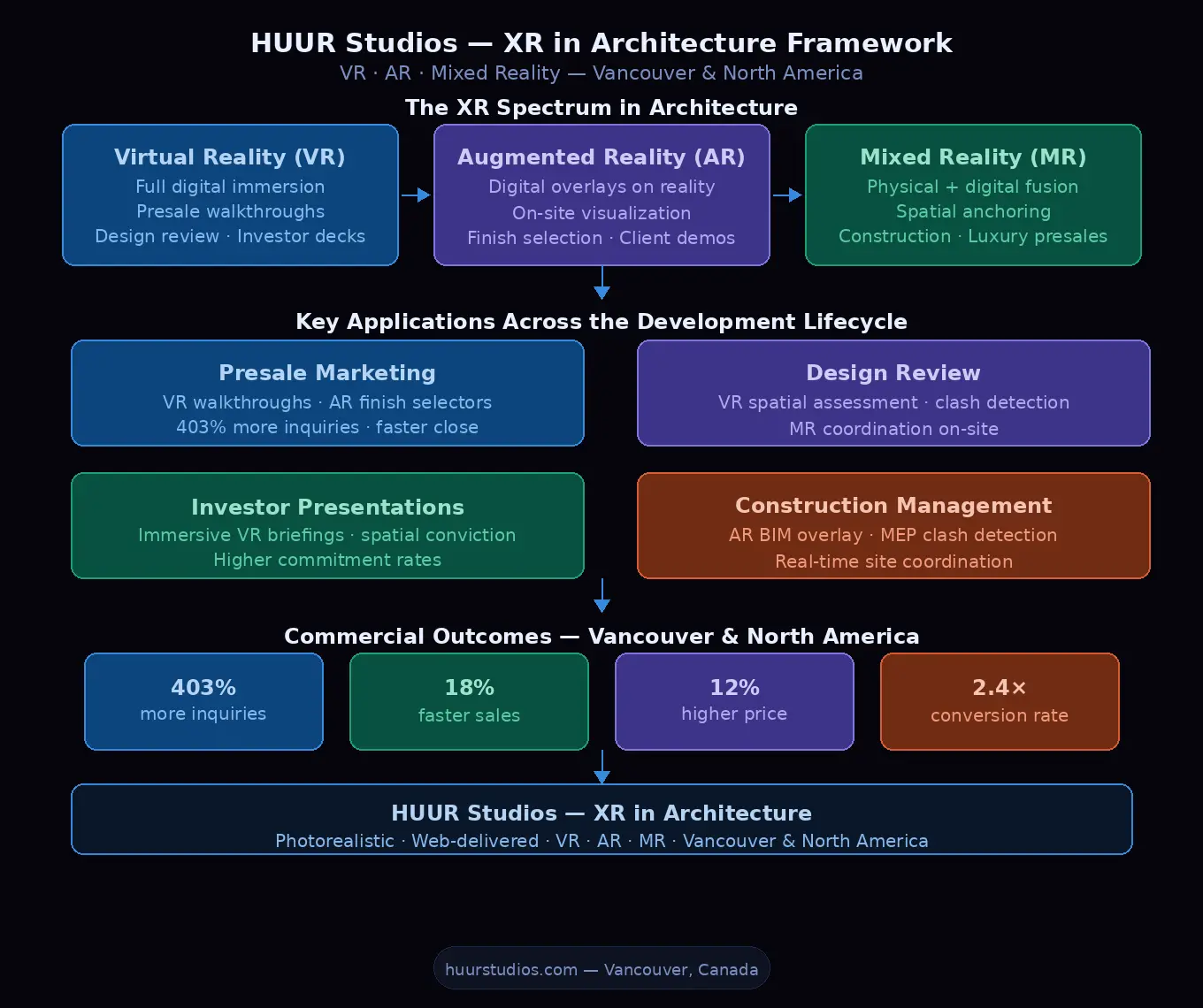
“Extended Reality (XR) is a term used to describe immersive technologies. Under the XR umbrella are:Virtual Reality (VR), which refers to a computer-generated simulation of a three-dimensional environment that can be explored by an individual, typically through the use of specialized electronic devices such as VR headsets. Augmented Reality (AR) on the other hand, is a technology that overlays digital information and computer-generated elements onto the real-world environment. Unlike virtual reality, augmented reality integrates digital content seamlessly with the physical world. Finally, Mixed Reality (MR) is a technology that combines elements of both virtual and augmented reality to create a hybrid environment where physical and digital elements coexist and interact in real-time. (ARCHITIZER)”
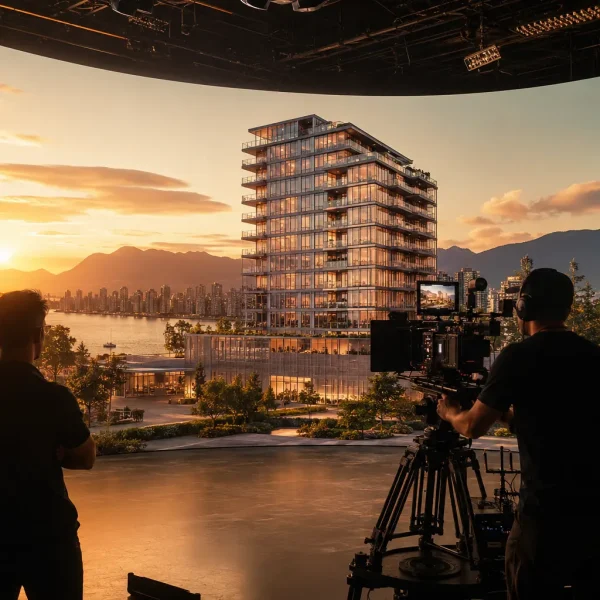
The architectural industry has always been defined by its ability to communicate spaces that do not yet exist. Blueprints gave way to physical models. Physical models gave way to static renders. Static renders gave way to virtual walkthroughs. Each transition expanded what was possible — but none transformed the client experience as fundamentally as XR in architecture is doing right now. For the first time in the history of architectural communication, clients can genuinely inhabit a space before a single foundation has been poured — moving through rooms, experiencing scale, feeling atmosphere, and making decisions with a level of spatial understanding that no previous visualization medium could provide.
For real estate developers, the commercial implications are immediate. Presale campaigns powered by XR in architecture tools — immersive VR walkthroughs, AR material overlays, mixed reality site experiences — are demonstrating measurably superior conversion rates, faster sales timelines, and higher buyer satisfaction scores than campaigns built on traditional visualization alone. This article explores exactly how XR in architecture works across its 3 primary forms, where each delivers the most value, and why HUUR Studios has positioned immersive XR experiences at the center of every visualization solution it delivers for North American clients.
What Is XR and How Does It Apply to Architecture?
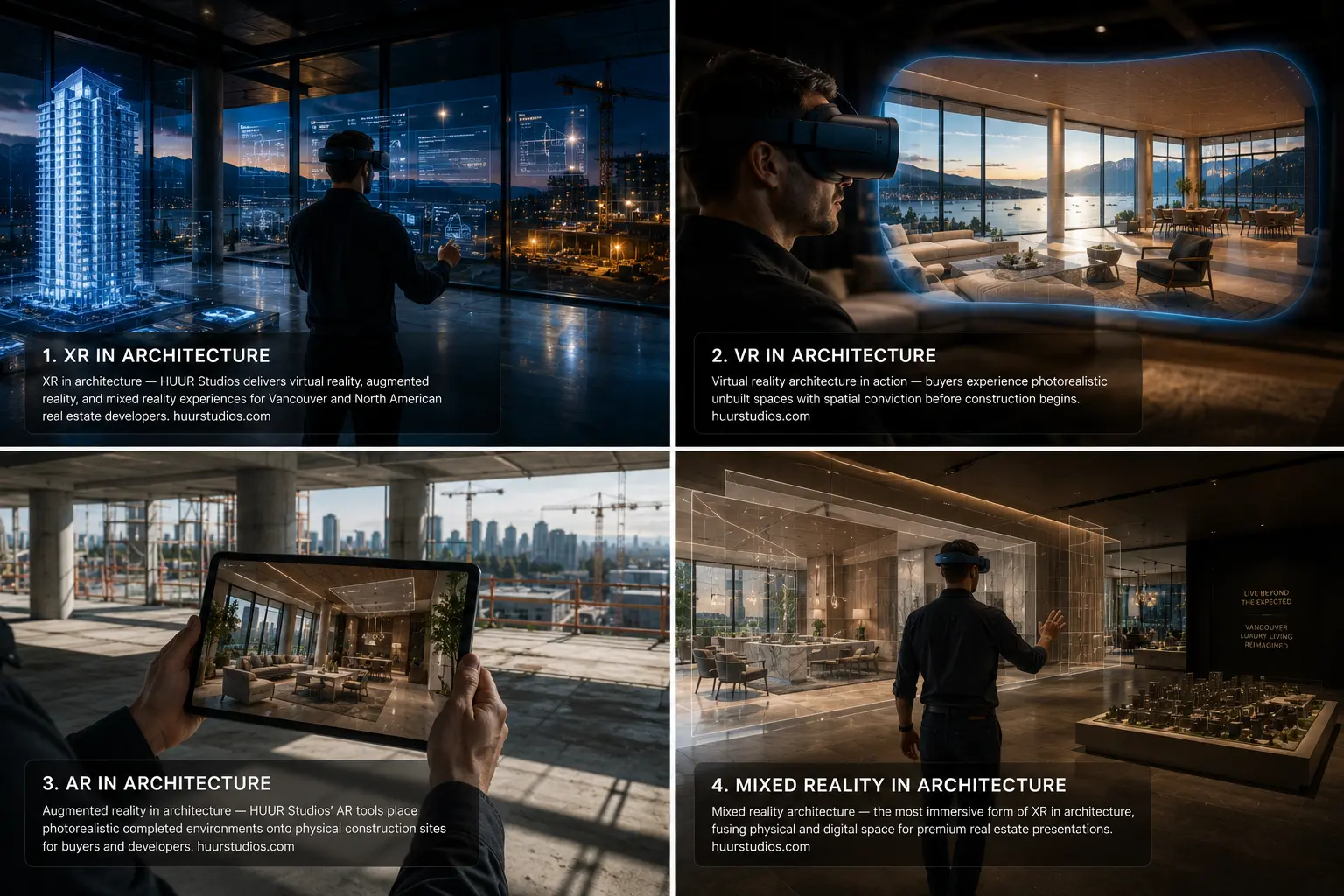
XR in architecture begins with a definition. XR — Extended Reality — is the collective term for the full spectrum of immersive digital experience technologies: virtual reality (VR), augmented reality (AR), and mixed reality (MR). Each operates differently, serves different purposes, and delivers different value within architectural and real estate contexts. Together they form a comprehensive toolkit that is transforming how the built environment is designed, reviewed, marketed, and experienced.
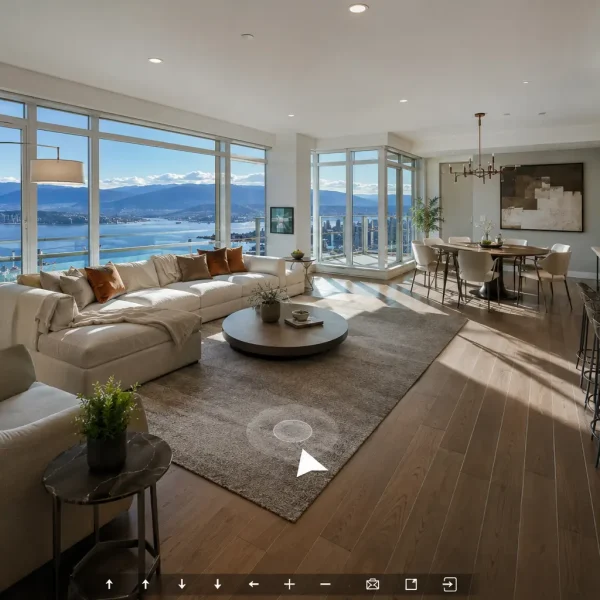
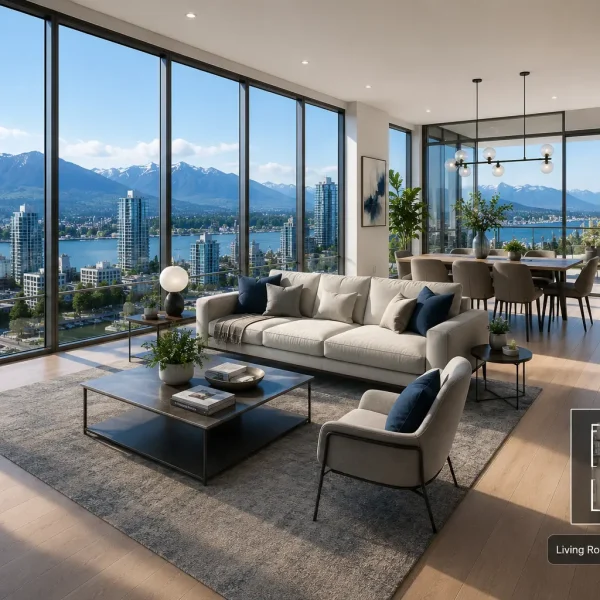
Virtual reality architecture places the user inside a fully digital environment. Wearing a VR headset, a client steps into a photorealistic model of a building that does not yet exist — walking through corridors, standing in living rooms, looking out windows at views that will one day be real. The environment is entirely simulated, completely immersive, and indistinguishable in quality from physical reality when executed at the standard HUUR Studios delivers.
Augmented reality in architecture overlays digital information onto the physical world. Using a smartphone, tablet, or AR headset, a user sees the real world enhanced with virtual elements — a proposed building superimposed onto an empty site, furniture placed within an unfinished interior, material finishes applied to bare concrete walls. AR does not replace reality — it enriches it with digital intelligence.
Mixed reality architecture sits at the intersection of these 2 approaches. Unlike pure AR, mixed reality anchors digital objects to physical space with spatial precision — they respond to real surfaces, cast realistic shadows, and remain fixed in position as the user moves around them. A mixed reality architectural experience allows a developer to walk through a physical site while viewing a life-size, spatially accurate model of the proposed building overlaid on the real environment.
XR as a Unified Architectural Communication Framework
The power of XR in architecture lies not in any single technology but in the ability to deploy the right XR tool at the right stage of the architectural journey. A project that begins with VR walkthroughs during the design review phase can transition to AR overlays during construction and mixed reality presentations for client handover — each stage leveraging the specific capabilities of its XR modality to deliver maximum value.
HUUR Studios approaches XR in architecture as a unified communication framework rather than a collection of separate technologies. Every project brief includes an XR strategy phase that maps which immersive technology serves each stakeholder at each project milestone. Architects receive design review environments optimized for spatial assessment. Sales teams receive presale VR experiences optimized for buyer engagement and conversion. Site managers receive AR tools that overlay construction documentation onto physical structure. The framework is continuous, coherent, and designed to deliver value at every stage of the architectural and real estate development lifecycle.
For Vancouver developers managing complex mixed-use projects with multiple stakeholder groups — architects, investors, municipal planners, presale buyers, and future tenants — this unified XR in architecture approach transforms how the project communicates across every audience simultaneously, using the most effective immersive technology for each context.
The Technology Infrastructure Behind XR in Architecture
XR in architecture runs on a technology stack that combines real-time rendering engines, spatial computing platforms, and delivery infrastructure. HUUR Studios builds its XR environments on Unreal Engine — the same platform powering the most visually demanding games and cinematic experiences in the world — ensuring that every virtual reality architecture, augmented reality, and mixed reality experience it delivers meets the photorealistic quality standard that North American luxury real estate clients expect.
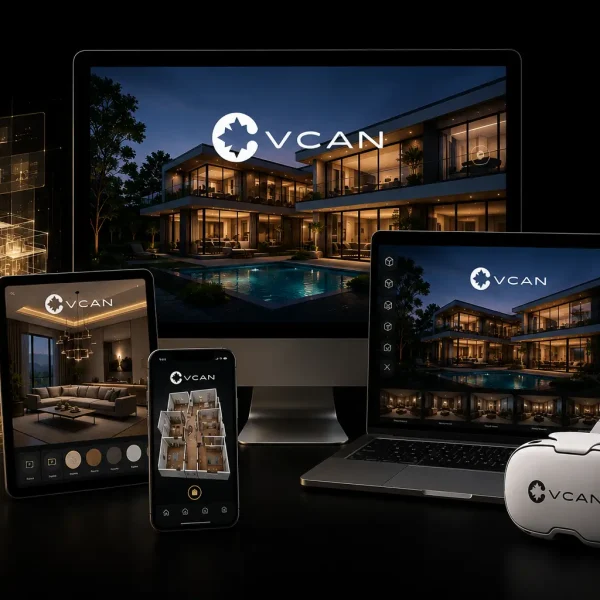
Hardware delivery spans the full XR spectrum. VR experiences are delivered through standalone headsets including Meta Quest and PC-tethered platforms including HTC Vive and Valve Index — selected based on the client’s presentation context and audience. AR experiences are delivered through iOS and Android devices using ARKit and ARCore frameworks, requiring no specialized hardware beyond a standard smartphone or tablet. Mixed reality architecture experiences are delivered through platforms including Microsoft HoloLens and Magic Leap for enterprise applications, and through web-based spatial AR for consumer-facing real estate marketing.
The result is an XR in architecture capability that scales from a single buyer standing in a sales suite to thousands of international buyers accessing an immersive property experience through a standard web browser — flexible, scalable, and always delivering the photorealistic quality that defines the HUUR Studios standard.
The Role of VR in Architectural Visualization and Design Review
Virtual reality architecture represents the most immersive application of XR in architecture — and the one with the longest track record of commercial deployment in the real estate and development sectors. VR places the user inside a complete digital environment, delivering a sense of spatial presence that no other visualization medium achieves. For architectural visualization, this means clients experience scale, proportion, light, and atmosphere in a way that transforms their understanding of a proposed space from intellectual to visceral.
The design review application of virtual reality architecture is where XR in architecture delivers some of its most significant professional value. Architects and designers who review their work in VR consistently identify spatial issues — ceiling heights that feel oppressive, corridors that read as narrower than their dimensions suggest, views that are partially obstructed by structural elements — that are invisible in 2D drawings and difficult to perceive in static renders. VR design review catches these issues at the design stage, before they become construction problems.
Presale VR Experiences That Close Deals
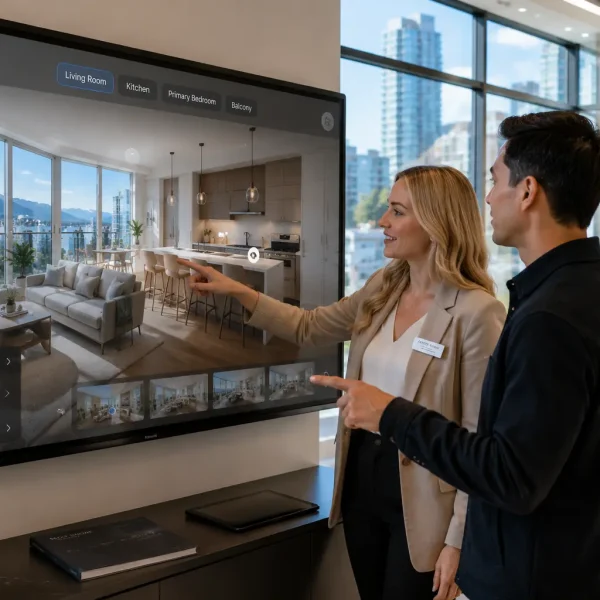
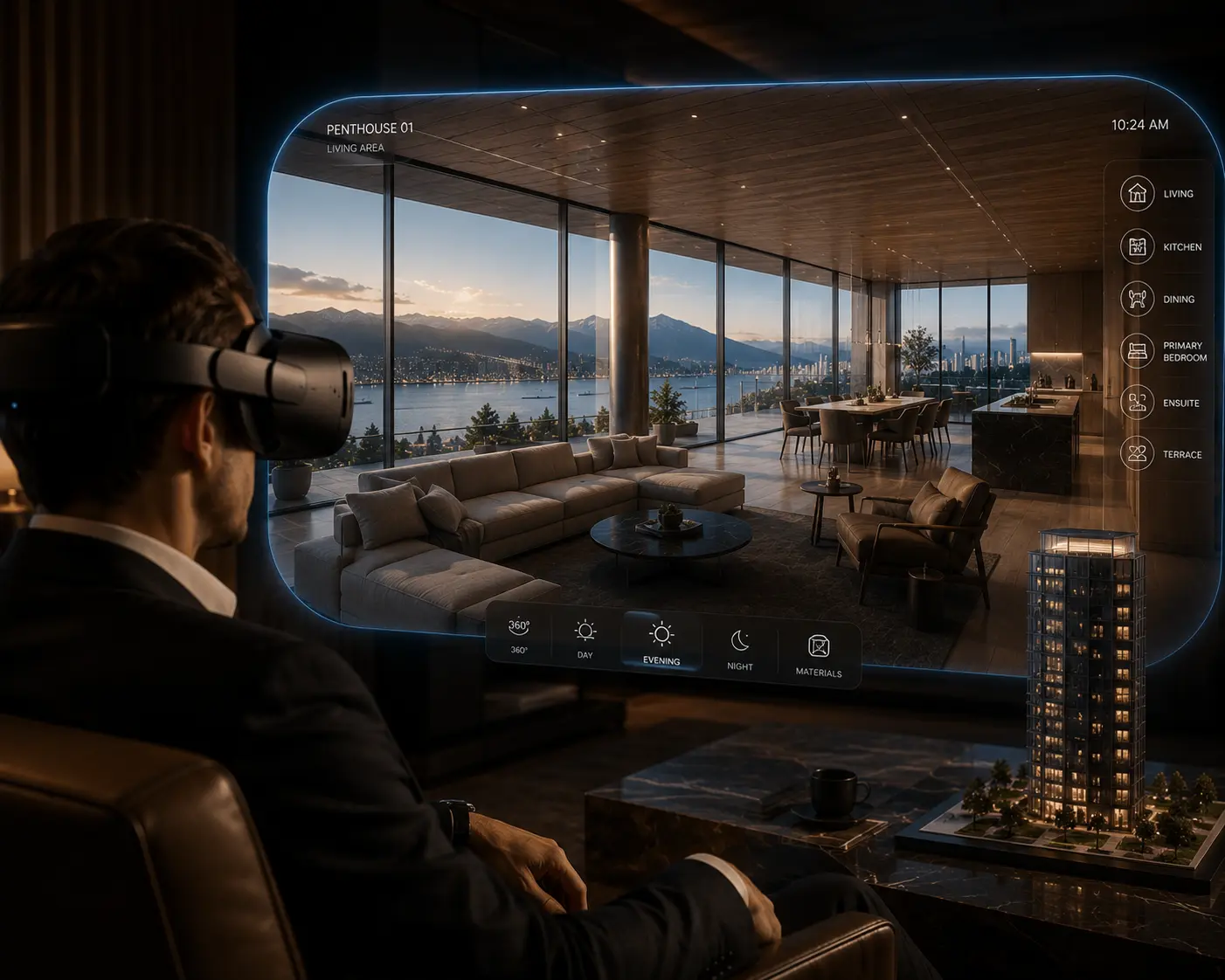
For real estate marketing, virtual reality architecture has demonstrated a commercial impact that justifies significant investment. HUUR Studios’ presale VR experiences are built specifically for the sales environment — optimized for non-technical users, deliverable on standalone headsets without complex setup, and designed to guide buyers through a narrative experience of the property rather than simply providing a navigable space.
The commercial evidence for VR in presale marketing is compelling. Studies from the National Association of Realtors confirm that listings featuring immersive virtual experiences receive 403% more inquiries than those without. For Vancouver developers operating in presale markets where individual unit values range from $800,000 to over $5 million, the ability to create genuine spatial conviction in a buyer before a unit is built is not a marketing luxury — it is a revenue-critical capability.
HUUR Studios has delivered virtual reality architecture experiences for residential developments across Vancouver, Victoria, and Calgary — consistently reporting that sales teams using VR in buyer presentations close at higher rates and with fewer post-sale revision requests than teams relying on printed materials alone. The spatial understanding VR creates aligns buyer expectations with delivered product in a way no static medium achieves — reducing the friction that generates post-sale dissatisfaction and protecting developer reputation in markets where word-of-mouth drives presale momentum.
VR for Investor and Stakeholder Presentations
Beyond presale buyer engagement, virtual reality architecture serves a critical role in investor and municipal stakeholder presentations — contexts where the ability to communicate design intent with spatial clarity can directly influence funding decisions and planning approvals. A real estate investment group evaluating a proposed mixed-use development in Vancouver’s evolving urban landscape responds differently to a VR walkthrough of the project than to a board of rendered images and floor plans.
XR in architecture at the investor presentation level communicates ambition and execution capability simultaneously. A developer who can place an investment committee inside a photorealistic VR environment of their proposed project demonstrates both the quality of the design and the sophistication of the development team — signals that influence confidence and commitment in ways that traditional presentation formats cannot replicate.
How AR Enhances On-Site and Client-Facing Experiences
Augmented reality in architecture occupies a distinct and highly practical position within the XR in architecture toolkit. Where VR replaces the physical environment entirely, AR enriches it — overlaying digital information, visualizations, and interactive elements onto the real world through a standard device screen or AR headset. This distinction makes augmented reality in architecture particularly valuable in contexts where the physical environment itself is part of the experience.
The on-site application of augmented reality in architecture is among the most commercially compelling use cases within XR in architecture. A prospective buyer standing on an empty development site — seeing nothing but cleared land, construction fencing, and foundation work — gains an entirely different understanding of the project when their smartphone or tablet overlays a life-size, photorealistic visualization of the completed building onto the physical landscape in front of them.
AR for Interior Visualization and Finish Selection
Augmented reality in architecture delivers particular value in interior design and finish selection contexts — the stage of the real estate sales process where buyers must make significant financial commitments based on material samples, brochure images, and their own spatial imagination. XR in architecture via AR transforms this process entirely.
HUUR Studios builds AR finish selection tools that allow buyers to point their device at any surface in a physical sales suite or unfinished unit and see their chosen materials — flooring, wall finishes, kitchen cabinetry, bathroom tile — rendered in photorealistic quality in the actual space, at full scale, in the real lighting conditions of the room. The guesswork that drives post-sale revision requests disappears. The buyer sees exactly what they are purchasing, in context, before signing.
For Vancouver real estate developers managing projects with multiple finish packages across dozens or hundreds of units, this AR capability reduces post-sale change requests, accelerates the finish selection process, and increases buyer confidence — all commercially significant outcomes in a market where carrying costs make sales velocity a primary financial priority.
AR in Construction and Project Management
The application of augmented reality in architecture extends beyond marketing into construction management — a dimension of XR in architecture that delivers operational as well as commercial value. AR construction tools overlay BIM models, structural drawings, MEP systems, and inspection documentation onto physical structure — allowing site managers, contractors, and architects to verify construction against design in real time.
For complex mixed-use developments in Vancouver’s dense urban construction environment, where coordination between multiple trades and precise adherence to design intent are critical, AR construction tools reduce errors, accelerate inspections, and improve communication between design and build teams. HUUR Studios integrates AR construction capability into its XR in architecture offering for clients who require visualization support across the full development lifecycle — from presale marketing through construction completion and tenant handover.
Mixed Reality as the Bridge Between Physical and Digital Space
Mixed reality architecture represents the most technically sophisticated application of XR in architecture — and the one that most completely fulfills the promise of seamlessly bridging the physical and digital worlds. Unlike AR, which overlays digital content onto a camera view of the real world, mixed reality uses spatial mapping technology to understand the physical environment in 3 dimensions — placing digital objects with precise spatial accuracy, allowing them to interact with real surfaces, and maintaining their position as the user moves freely through both physical and digital space simultaneously.
For XR in architecture, mixed reality creates possibilities that neither VR nor AR can achieve independently. A developer using mixed reality can walk through a physical construction site while simultaneously experiencing the completed design at full scale — seeing finished walls rise from bare concrete, watching interior spaces take shape within structural frames, and evaluating design decisions against physical reality rather than digital simulation alone.
Mixed Reality for Design Coordination and Clash Detection
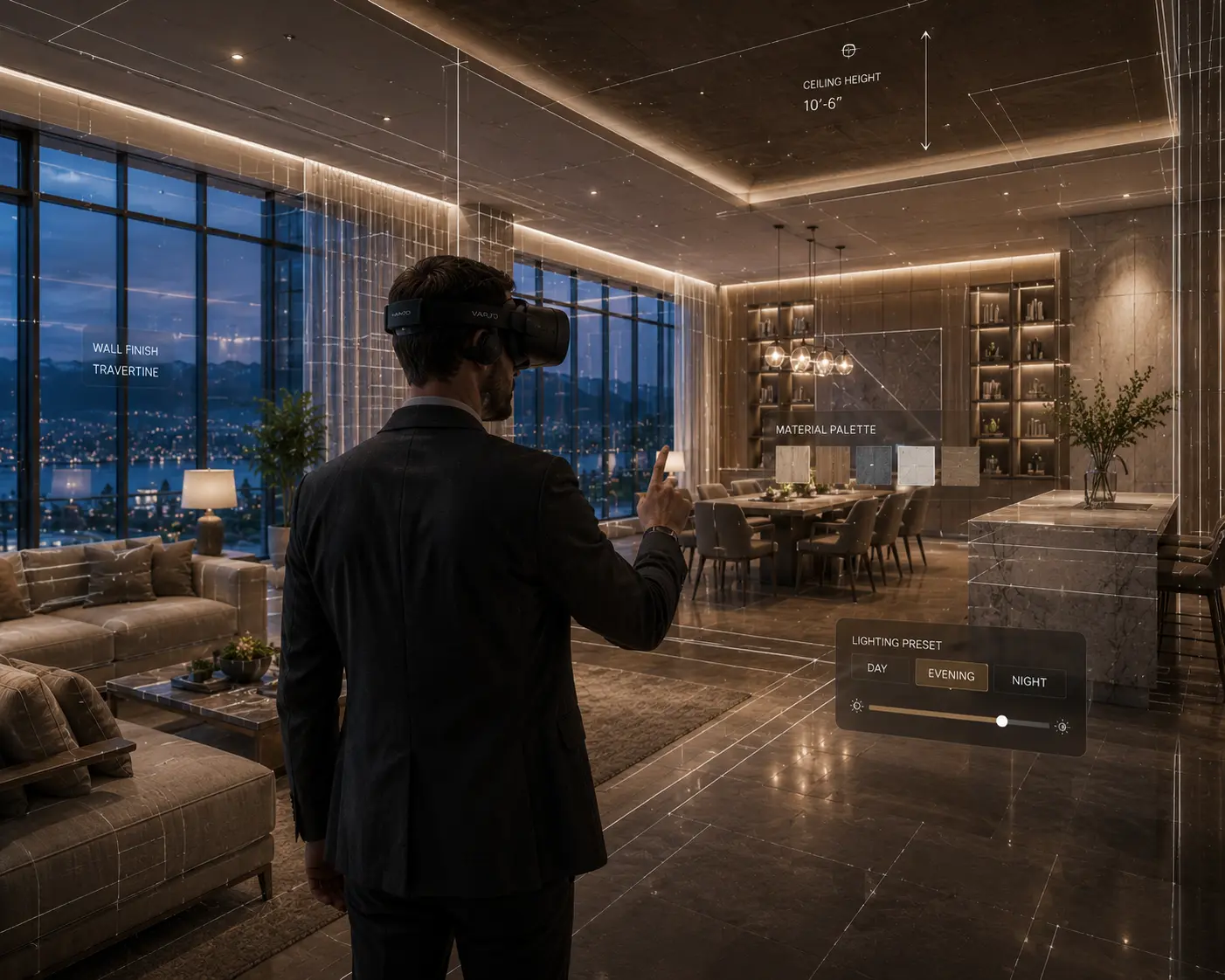
Mixed reality architecture delivers significant professional value in design coordination contexts where XR in architecture intersects with the technical demands of complex building delivery. Spatial clash detection — identifying conflicts between structural, mechanical, electrical, and plumbing systems before they become costly on-site problems — is a process that mixed reality transforms from a desk-based model review exercise into a physically immersive coordination experience.
HUUR Studios has delivered mixed reality architecture coordination tools for commercial development projects across British Columbia — enabling design teams to walk through physical construction environments while viewing overlaid MEP systems, structural elements, and architectural finishes at full scale. Coordination issues that would previously require multiple rounds of 2D drawing review and site meetings are identified and resolved in a single mixed reality session — reducing coordination costs and accelerating construction timelines in markets where every day of delay carries significant financial consequences.
Mixed Reality Presentations for Premium Real Estate
Mixed reality architecture is also emerging as a premium presentation tool for high-value real estate transactions — particularly for off-plan sales of luxury residential and commercial properties where the buyer’s investment warrants a correspondingly sophisticated visualization experience.
HUUR Studios delivers mixed reality architectural presentations for Vancouver’s luxury development sector — experiences where buyers wearing mixed reality headsets walk through a physical sales suite while seeing the proposed unit materialize around them at full scale, with finished surfaces, furniture, and views rendered in photorealistic quality anchored precisely to the physical space. The experience is categorically different from any other visualization medium — not a screen showing a space, not a headset replacing reality, but a genuine fusion of physical and digital that creates the most compelling and convincing presale experience XR in architecture currently makes possible.
Why XR Is Becoming a Standard Tool in Architecture and Real Estate
XR in architecture has crossed the threshold from innovative differentiator to competitive necessity in North America’s leading real estate markets — and Vancouver is among the cities where this transition has happened fastest. The combination of a technically sophisticated buyer demographic, intensely competitive presale marketing environment, and strong technology adoption culture across the architectural and development community has made Greater Vancouver one of the most advanced XR real estate visualization markets in the world.
The commercial drivers behind this standardization are consistent across market segments. For luxury residential developers, XR in architecture tools deliver faster sales cycles, higher average transaction values, and reduced post-sale friction. For commercial developers, they accelerate investor commitment and improve design coordination efficiency. For architects and design firms, they enable more effective client communication, reduce revision cycles, and differentiate service offerings in competitive pitches.
The Accessibility Revolution in XR Technology
One of the most significant factors driving the standardization of XR in architecture is the dramatic improvement in accessibility that has occurred over the past 3 years. Hardware costs have fallen substantially — standalone VR headsets that cost $3,000 in 2021 are available for under $500 in 2026. AR experiences that previously required custom app development now deploy through standard web browsers using WebXR — accessible on any smartphone without a download.
This accessibility shift means that XR in architecture is no longer a tool reserved for landmark projects with exceptional marketing budgets. A mid-market residential developer in Calgary or a commercial architect in Toronto can now deploy professional-quality XR visualization experiences at price points that deliver clear positive ROI. HUUR Studios has structured its XR in architecture service offering to serve this full market spectrum — from web-based AR finish selectors for volume residential projects to bespoke mixed reality presentations for ultra-luxury developments — ensuring that every client accesses the immersive visualization capability their project and audience requires.
Interactive Spatial Design as the New Client Standard
Interactive spatial design — the ability for clients to actively participate in and configure the spaces they are purchasing — has emerged as the defining characteristic of next-generation XR in architecture deployment. Buyers who engage with interactive spatial design tools during the presale process report significantly higher satisfaction with their purchase decision, lower rates of post-sale change requests, and stronger referral behavior than buyers who experienced only passive visualization.
HUUR Studios builds interactive spatial design capability into every XR in architecture project — ensuring that clients are not passive observers of a visualization but active participants in the experience of their future space. This interactivity transforms the commercial relationship between developer and buyer: rather than selling a fixed product to a passive purchaser, the developer enables a co-creation experience that builds emotional investment, reduces decision anxiety, and creates the kind of buyer conviction that drives presale momentum in any market condition.
FAQ — XR in Architecture Explained
1. What does XR mean in architecture? XR in architecture stands for Extended Reality — the collective term for virtual reality, augmented reality, and mixed reality technologies applied to architectural visualization, design review, and real estate marketing. XR enables clients and designers to experience spaces that do not yet exist with unprecedented spatial realism and interactivity.
2. How is VR used in architectural visualization? Virtual reality architecture places users inside photorealistic digital environments — allowing buyers to walk through proposed spaces, experience scale and atmosphere, and make purchase decisions with genuine spatial understanding. VR is used for presale marketing, design review, investor presentations, and stakeholder engagement across North American real estate markets.
3. What is the difference between AR and mixed reality in architecture? Augmented reality in architecture overlays digital content onto a camera view of the physical world — ideal for on-site visualization and finish selection. Mixed reality architecture uses spatial mapping to anchor digital objects to physical space with 3D precision — creating a genuine fusion of physical and digital environments. Mixed reality is more immersive and technically sophisticated than standard AR.
4. Is XR mainly used for design or also for real estate marketing? XR in architecture serves both disciplines equally. For design, VR and mixed reality support spatial review, coordination, and clash detection. For real estate marketing, immersive VR walkthroughs, AR finish selectors, and mixed reality site presentations deliver measurably superior buyer engagement and conversion rates — making XR in architecture one of the highest-ROI tools available to North American real estate developers.
The future of architecture is no longer limited to drawings, renders, or static presentations.
Today’s most successful developments are experienced through immersive XR environments that allow clients, investors, and buyers to step inside a project long before construction begins.
At HUUR Studios, we create high-end XR experiences that combine virtual reality, augmented reality, mixed reality, and cinematic real-time visualization to transform how architectural projects are communicated, approved, and sold.
From immersive presale walkthroughs to interactive mixed reality presentations, our goal is simple: helping your audience feel the space before it exists.
Connect with our team to explore how XR in architecture can elevate your next project.
Conclusion
XR in architecture is no longer a vision of what architectural visualization might become — it is what the best studios, the most competitive developers, and the most sophisticated real estate markets in North America are already deploying at scale. Virtual reality architecture, augmented reality in architecture, and mixed reality architecture each deliver distinct and measurable value across the design, marketing, and construction phases of every project they touch — and together they form the most powerful immersive communication toolkit the built environment industry has ever had access to.
HUUR Studios builds XR in architecture experiences that combine photorealistic visual quality, interactive spatial design, and web-accessible delivery — serving developers, architects, and real estate brands across Vancouver, British Columbia, and North America with immersive visualization solutions that drive commercial results. From VR presale environments to AR finish selectors to mixed reality site presentations, every HUUR Studios XR in architecture project is designed to do one thing above all else: create the spatial conviction that transforms interest into commitment.
If your next project deserves to be experienced rather than simply described, XR in architecture is what HUUR Studios delivers.